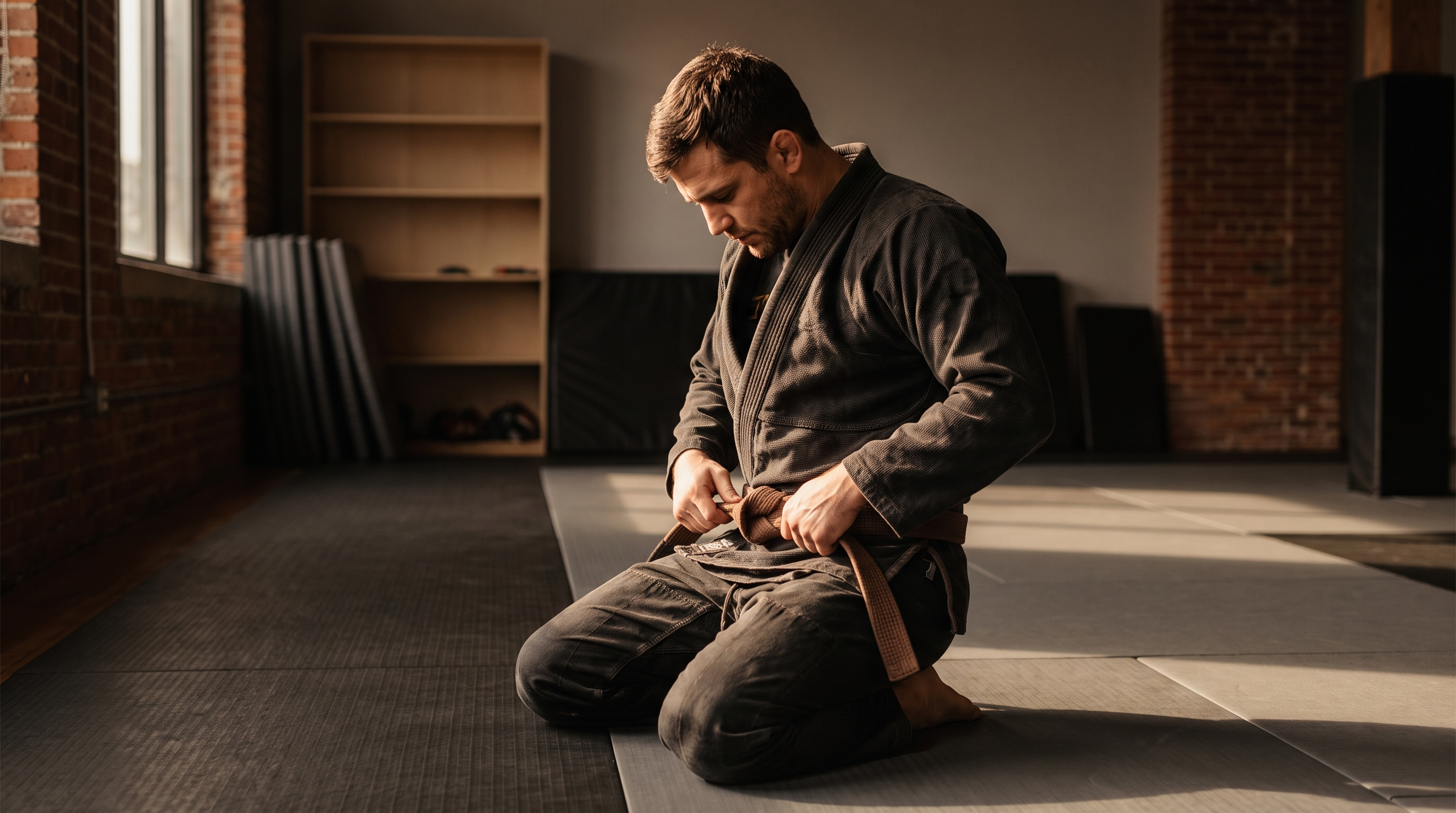
Masters Division Grappler's Guide: How to Train BJJ Smart After 35 Without Breaking Down
TL;DR. BJJ training after 35 is a different sport than what the 22-year-olds do — and pretending otherwise is what breaks masters grapplers. The winning formula is fewer hard rounds, more technical work, non-negotiable recovery, and a system to remember what you learn so mat time compounds instead of resetting. Pick your rolls carefully, protect your neck and knees, and treat sleep as training. Build a personal technique library you actually revise between sessions, and you can keep improving well past 35, 45, and beyond.
Key takeaways
- Masters grapplers progress by training smarter and recovering harder — not by matching the volume of younger competitors.
- The biggest career-ending mistake after 35 is ego rolling with athletic 20-somethings without protecting neck, knees, and fingers.
- A short daily routine of technique review (5–15 minutes) beats occasional marathon sessions for long-term retention.
- Sleep, protein intake, and one full rest day per week are training inputs, not optional extras.
- Selective rounds work: pick your training partners and intensity deliberately instead of accepting every roll.
- Building a personal technique library — cards you can revise before class — turns each session into cumulative progress.
- Masters can absolutely still get better at BJJ; the game just shifts toward leverage, timing, and grip efficiency.
The masters grappler's specific constraint: your body keeps the score
If you started BJJ in your 30s or 40s — or you've been training since your 20s and now feel every knee twist for a week — you already know the core constraint: you don't get to train like a 22-year-old competitor anymore. Not because you're weak, but because your recovery window is longer, your soft tissue is less forgiving, and your life outside the mats (kids, work, a spine that remembers every desk hour) doesn't pause while you heal.
Masters division grapplers face a very specific squeeze:
- Recovery is slower. A hard 6-round Saturday session can echo into Tuesday.
- Injuries stack. A tweaked knee at 25 was a two-week problem. At 40, it can become the reason you can't play half guard for a year.
- Time is scarce. Two or three sessions a week is realistic; five is rare and usually costly.
- Memory feels shorter. You learn a beautiful detail in class Monday and by Friday you can't remember which grip came first.
None of this means you should stop. It means your framework has to change. The masters who keep improving after 35 aren't the ones grinding harder — they're the ones who accept the constraint and design around it.
Remember. Your job as a masters grappler is not to survive class. It's to leave every session slightly better than you arrived, with your body intact and one small thing you can actually recall next week.
The daily 5–15 minute structure that actually compounds
Most masters grapplers train two or three times a week. That's fine — but the days between class are where your progress leaks. The fix isn't more mat time. It's a short, honest daily habit that keeps techniques in your head so they're available when you finally get to drill them.
Here's a realistic structure that fits into a lunch break, a morning coffee, or the ten minutes before your kids wake up.
5-minute version (busy days)
- Open your notes or technique library.
- Read one card from your last class — the exact detail your coach corrected.
- Mentally rehearse the sequence. Feel the grip, the weight shift, the frame.
- Close everything. That's the rep.
A visual, focused re-read of one technique beats scrolling three unrelated Instagram highlights. The point is retrieval, not consumption.
10-minute version (a normal day)
- 2 minutes: re-read yesterday's technique card.
- 3 minutes: watch a short clip of the same move (an instructional, a competition angle) to reinforce the visual.
- 3 minutes: shadow-drill the entry on the floor at home — no partner needed for grip fighting and hip movement.
- 2 minutes: write one line about what you'll try next class.
15-minute version (weekend deep work)
- 5 minutes: review your last three sessions' notes.
- 5 minutes: pick one technique to focus on this week and study it more carefully.
- 5 minutes: shadow-drill and mentally connect it to positions you actually get to.
This is the retention engine masters grapplers need. It costs almost nothing in physical recovery, and it turns each class from an isolated event into a chapter in a book you're actually writing.
The common failure pattern (and how to fix it)
Almost every masters grappler I've watched burn out or get seriously hurt fell into the same pattern. It looks like this.
The pattern:
- They train two or three times a week and love it.
- A younger, athletic training partner shows up. Ego kicks in.
- They take every hard round, refuse to tap early to a scramble, and use strength to escape when technique fails.
- Something tweaks — usually a knee, neck, shoulder, or finger.
- They keep training on it because "it's not that bad."
- Two months later they're on the couch, out for a season, and lose the retention they'd built.
The fix isn't complicated, but it takes discipline:
1. Pick your rounds
You don't owe anyone a hard round. Warm up with a technical roll. Choose one or two rounds per session to push. Flow with the rest. When a strong new partner asks, it's completely acceptable to say, "let's start slow." Real training partners respect it.
2. Tap early, tap often
At 40 your ligaments don't care that you "had the escape." If a heel hook or kimura is deep, tap. You are not competing for a world title in Tuesday open mat.
3. Protect the non-negotiables
- Neck: avoid stacking positions where your neck is loaded and someone can drop weight. Learn to bail on inverted positions if you're not warm.
- Knees: be very careful with reaping, leg entanglements, and explosive stand-ups from turtle. Tape when needed.
- Fingers: rotate grips. Consider taping fingers preventively in the gi.
4. Treat recovery as training
Sleep, protein, water, and one truly rest day a week. If you're limping into class, you're not training — you're just paying dues to an injury.
Remember. The masters grappler's superpower is not intensity. It's showing up next week, and the week after, uninjured and slightly better than last time.
The BJJ Memo feature that helps most: your personal technique library
One of the quiet reasons masters grapplers plateau isn't physical — it's memory. You learn a detail on Monday. Wednesday you drill something different. By Friday's open mat, Monday's detail is gone. Repeat this for a year and you feel like you're spinning your wheels.
The single most useful thing BJJ Memo does for a masters grappler is give you a personal technique library built from the videos and classes you already study. You paste a BJJ YouTube URL — an instructional, a competition breakdown, a coach's clip — and the app turns it into a structured Technique Card: clear steps, key details, and tappable timestamps of the visual moments that matter. The card is filed into your searchable library, and a review flow helps you revise techniques before your next session.
For a masters grappler with two or three sessions a week, that library is the difference between "I vaguely remember something about the underhook" and "I know exactly what my coach corrected on Monday, and I'm about to try it." It's the retention layer your body's slower recovery makes essential.
You don't need it to still get better. But if your problem is "I train, then I forget" — this is the wedge that fixes it. You can learn more on the BJJ Memo homepage or read our guide on how to remember BJJ techniques.
Sample 7-day plan for a masters grappler
This is a realistic week for a working adult training BJJ three times per week. Adjust days to your schedule. The point isn't the exact template — it's the balance: three mat sessions, two active recovery days, one full rest, and a daily 5–15 minute revision habit that keeps techniques in your head.
| Day | Mat time | Off-mat work | Revision (5–15 min) |
|---|---|---|---|
| Mon | 60–75 min class · 2 selective rounds | Light mobility, 8h sleep target | Review last week's top card |
| Tue | Rest | Walk, hydrate, protein focus | Read today's new class card |
| Wed | 60–75 min class · 1 hard, 2 flow | Short shadow-drill at home | Watch the clip that matches Monday's detail |
| Thu | Rest | Strength: 20–30 min lower-body basics | Mental rehearsal of one entry |
| Fri | Optional open mat · flow only | Sauna, stretching, or yoga | Rewrite one card in your own words |
| Sat | 60–90 min class · 2 rounds max hard | Big protein meal, early sleep | Review the week's cards |
| Sun | Full rest | Long walk with family | Plan one focus technique for next week |
A week like this looks unimpressive on paper compared to the seven-day-a-week grinders. But if you run it for a year without injury, you will pass most of them.
Remember. Consistency beats intensity every time, and consistency for a masters grappler means "still training in twelve months," not "crushed it this week."
How the masters game actually shifts
A quick note on style, because a lot of masters grapplers waste years fighting this. The techniques that reward you at 25 — explosive guard passing, wild scrambles, deep leg entries at full speed — are often the ones that punish you at 40. That doesn't mean you can't do them. It means your default game should lean into what ages well:
- Pressure passing over speed passing.
- Closed and half guard with strong frames over deep inverted guards.
- Grip efficiency — winning the grip fight so you don't burn cardio.
- Timing — countering movement instead of forcing it.
- Sub finishes from dominant position rather than desperation.
You can still develop a modern game. You just build it around a body that has to last.
Frequently asked questions
Is it too late to start BJJ after 35?
No. Plenty of practitioners start in their late 30s, 40s, and even 50s and reach purple, brown, and black belt. What matters is training consistency, choosing a good academy, and protecting your body so you can keep showing up. Progress is slower than a 22-year-old's, but it's absolutely real.
How many times per week should a masters grappler train BJJ?
For most working adults over 35, two to three sessions per week is a sustainable sweet spot. Some people can handle four; five is usually where injuries and burnout start. Track how you feel two days after each session — if you're consistently sore or tired, dial back rather than push through.
How do I stop forgetting techniques between classes?
Capture the technique the same day, in your own words, with the key detail your coach corrected. Then revise it briefly before your next class. A simple notebook works. A structured library like BJJ Memo works better because you can search it and it prompts you to review. The trick is doing it consistently, not the tool you use.
Should masters grapplers compete?
If you enjoy it, yes — masters divisions exist for a reason and can be enormously fun. Just recognize that competition camps compress your training and raise injury risk. Pick one or two events a year, taper properly, and don't chase medals at the cost of your long-term training life.
What's the single biggest mistake older BJJ practitioners make?
Ego rolling with young athletes and refusing to tap early. Nearly every serious injury I've seen in a masters grappler comes from this exact scenario. Learn to say "let's flow," tap early to deep submissions, and remember that Tuesday open mat is not Worlds.
How important is strength training for BJJ after 35?
More important than it was at 25. A short lower-body and posterior chain routine two times a week protects your knees, hips, and lower back. You don't need to be a powerlifter — you need a body that tolerates the shapes BJJ forces you into.
Train the smart way, and the mats stay open forever
Masters BJJ isn't a compromise. It's a different, in many ways deeper version of the same sport — one where you get rewarded for patience, technique, timing, and consistency, all of which you have more of than the 20-year-olds do. The single thing that ends most masters careers isn't age; it's a preventable injury from a round that wasn't worth taking, or a slow fade because nothing they learned stuck.
If your bottleneck is retention — techniques evaporating between sessions — the fix is a small daily habit and a system to hold what you learn. Next time you watch an instructional or come home from class with a detail worth keeping, save it as a technique card in BJJ Memo so it's there, ready to revise, before your next roll. Build your library, protect your body, and you can keep getting better on the mats for a very long time.
For real feedback and safety, train the techniques at a legit academy with a qualified coach — BJJ Memo helps you remember and revise, it doesn't replace mat time. Explore more articles on the BJJ Memo blog.
Last updated 2026-09-29.