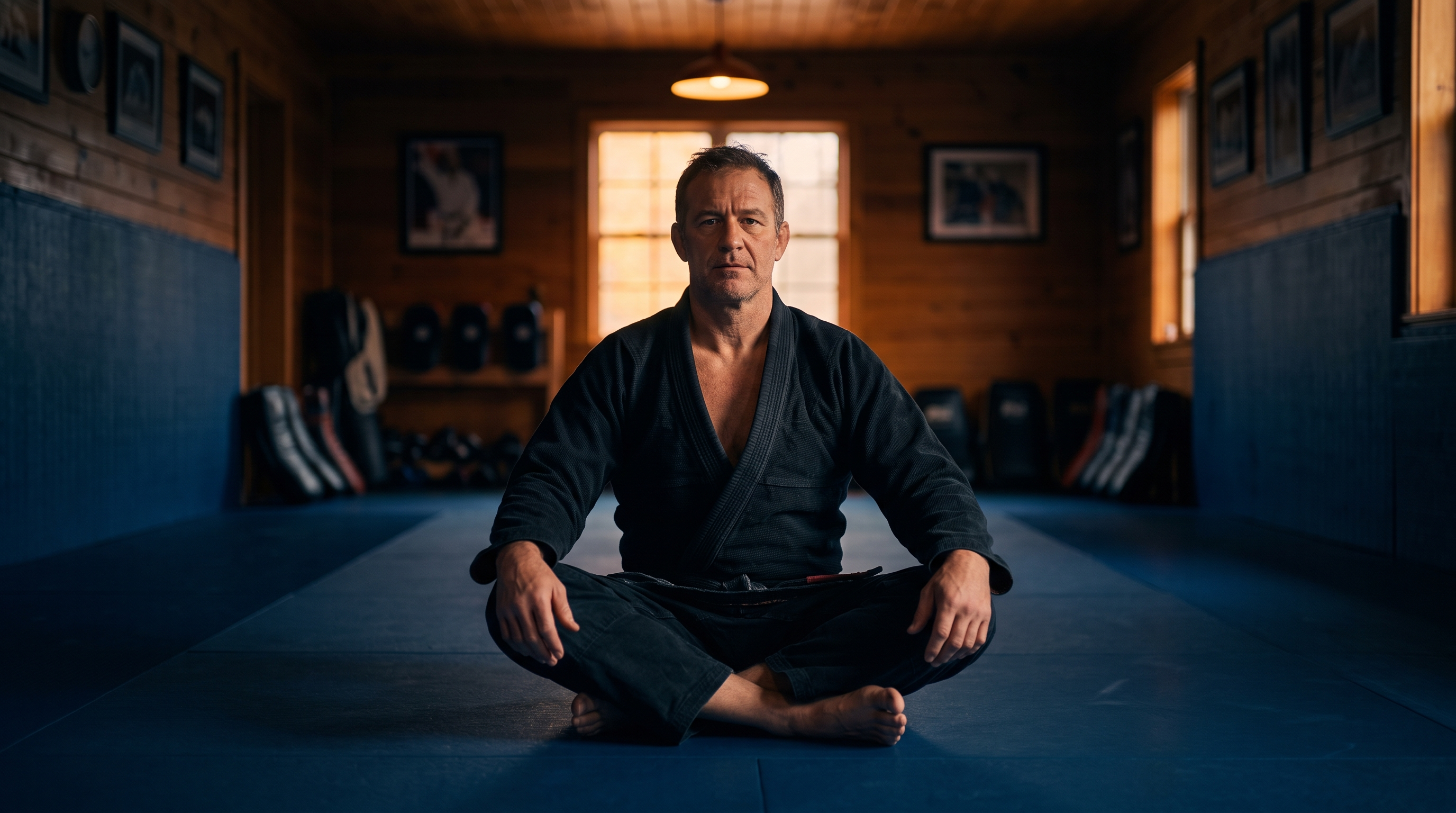
The Older Grappler's Guide: How to Keep Training BJJ Safely After 40
TL;DR. Training BJJ after 40 is absolutely doable, but the game changes: recovery becomes the real bottleneck, ego becomes the biggest injury risk, and technique retention matters more than the number of rounds you survive. The older grappler wins by training less but smarter — fewer explosive rolls, more positional work, structured warm-ups, and a system to remember what you learn between sessions. This guide gives you a daily 5–15 minute off-mat routine, the most common failure pattern (and how to fix it), and a 7-day sample plan you can copy this week.
Key takeaways
- Recovery, not conditioning, is the true limiter for grapplers over 40 — plan rest and mobility as seriously as training days.
- Tap early, roll with intention, and pick your partners: ego injuries end more masters-age careers than technique gaps.
- Two to three focused sessions per week beat five exhausted ones for long-term progression.
- Positional sparring and flow rolling deliver most of the learning at a fraction of the joint cost of full-intensity rounds.
- Retention becomes a bigger deal after 40 — you learn slower and forget faster, so a repeatable review habit matters.
- Warm-ups, sleep, and protein are not optional add-ons; they are part of your BJJ training.
- Longevity in jiu jitsu comes from consistency over years, not intensity over months.
The constraint older grapplers actually face
If you are starting or returning to BJJ after 40, you are not the same athlete a 22-year-old is. That is not a limitation — it is a design brief. Your body recovers slower, your joints have more mileage, and your schedule usually includes work, family, and sleep debt. On the flip side, you have patience, focus, and a much clearer sense of what you actually want out of training.
The single specific constraint you have to plan around is recovery capacity. A younger grappler can roll hard five nights a week and bounce back by morning. After 40, the bill lands later — stiff neck the day after, tweaked knee three days after that. Every training decision (how hard, how often, with whom, in what position) should be evaluated against one question: can I train again in 48 hours without breaking down?
That single filter reshapes everything: your warm-ups become non-negotiable, your rolling partners get chosen deliberately, your intensity is dialed on purpose, and you finally start caring about sleep and protein the way jiu jitsu media has been telling you to for years.
Remember. Your competition is not the 25-year-old blue belt across from you. It is the version of yourself who quit BJJ at 47 because their back gave out. Beat that guy.
The mindset shift: from surviving rounds to studying the game
Younger training culture rewards toughness. Masters-age training rewards learning. Every round is data — where did I get stuck, what grip broke my posture, why did that sweep work. If you leave class remembering one specific detail you can drill next time, you had a productive session, even if you tapped ten times.
This is where the older grappler has a real, unfair advantage: you can focus, take notes, and think in systems. Use it.
A daily 5–15 minute off-mat routine
You do not need a gym membership or a mobility guru. You need a short, boring, repeatable routine you do on non-training days (and ideally on training days too). The goal is not to get "in shape." The goal is to keep the joints, spine, and connective tissue that BJJ punishes ready for the next session.
A workable structure looks like this:
5-minute version (baseline — do this daily)
- 90 seconds of hip work. 90/90 switches, deep squat sits, cossack shuffles. Anything that opens hips and asks your knees to move through range.
- 90 seconds of spine work. Cat/cow, thoracic rotations on hands and knees, a couple of controlled bridges.
- 60 seconds of neck work. Slow rotations, gentle side flexion, chin tucks. Your neck is the first thing to complain after a hard rolling night.
- 60 seconds of grip work. Towel hangs, rice bucket, or slow farmer holds. Grips fail before technique does after 40.
15-minute version (2–3× per week)
Add on top of the baseline:
- 5 minutes of light strength. Split squats, push-ups, single-leg glute bridges, dead hangs. Bodyweight is enough. The point is joint integrity, not hypertrophy.
- 5 minutes of technique review. Sit down, pull up your notes or your saved technique cards, and mentally rehearse two or three specific details from your last class. This is when learning consolidates.
The review block is the one most grapplers skip and the one that matters most. When you are 25, you drill a move ten times and it sticks. After 40, you often need to see it again between sessions or it fades. Building a small revision habit is the difference between accumulating technique and endlessly re-learning the same escape.
The most common failure pattern (and how to fix it)
There is one mistake almost every older grappler makes, and it kills more masters-age careers than any joint. It looks like this:
Start BJJ at 42 → love it → train four to five times a week for two months → get a shoulder tweak → try to train through it → get another tweak → take three weeks off → come back tentative → cycle repeats → quit at 44.
The pattern is too much, too fast, too hard, too proud. Not enough recovery, too many hard rounds against sharp younger training partners, and refusal to modify or sit out when the body sends warning signs.
The fix, in four rules
- Cap hard rolls per week. Two to three genuinely hard rounds is plenty for someone over 40. The rest should be flow rolling or positional sparring. This alone will change your training life.
- Tap early. Tap often. Tap on principle. A submission you "survive" at 42 is a torn ligament at 43. The tap costs you nothing. The injury costs you months.
- Choose partners deliberately. You do not have to roll with the frantic new white belt or the college wrestler having a bad day. "No thanks, next round" is a complete sentence.
- Deload weeks are training. Every 4–6 weeks, cut volume in half for a week. You will come back sharper, not softer.
Remember. The best submission for a grappler over 40 is the one you didn't need to escape because you never got there. Position, posture, and grip control are your longevity insurance.
Modify, don't quit
Sore knees? Skip takedowns and start every round on the ground. Bad shoulder? Ask your partner to avoid kimuras and americans for a few weeks. Neck acting up? No stack passes, no inversions today. Almost every coach will respect a clearly communicated modification. Very few will respect you limping around for a month because you were too proud to say something.
The BJJ Memo feature that helps most: your Technique Card library
Here is where retention becomes a real training tool. The one thing we built BJJ Memo around is the Technique Card library — and for the masters-age grappler, it is the single most useful feature we can point to.
Here is why. You watch a Lachlan Giles half-guard breakdown on YouTube on Tuesday. You go to class Wednesday and drill a completely different position. By Friday, most of the Tuesday details are gone. That is not a personal failing — it is how memory works, and it accelerates with age.
With BJJ Memo, you paste the YouTube URL and the app turns the video into a structured Technique Card: the steps, the key details, and tappable timestamps of the important visual moments. That card lands in your personal library, sorted by position. Before your next training night, you spend two minutes revising the card instead of trying to re-watch a 25-minute video you half-remember.
The result is the retention loop older grapplers desperately need:
- Capture what you learn (in class or from a video) before it fades.
- Organize it by position so your "game" starts to have shape.
- Revise two or three cards before your next session so the details are fresh when you step on the mat.
We are intentionally not going to list five more features here. If you want to try one thing that will change how much you actually retain, it is this one. Learn more on the BJJ Memo homepage or read our guide to learning BJJ from YouTube.
A sample 7-day plan for the grappler over 40
This is a template, not a prescription — adjust it to your schedule, your body, and your academy's timetable. It assumes three mat sessions per week, which is a sustainable sweet spot for most masters-age grapplers.
| Day | Session | Focus | Intensity | Off-mat |
|---|---|---|---|---|
| Mon | Class (60–90 min) | Technique + positional sparring | Moderate | 5-min mobility before bed |
| Tue | Rest | Recovery | — | 15-min routine + revise 2 technique cards |
| Wed | Class (60–90 min) | Technique + 2 hard rolls, rest flow | Hard (capped) | 5-min neck & hip work |
| Thu | Rest | Recovery | — | Walk, sleep, hydrate; revise 2 cards |
| Fri | Class (60–90 min) | Open mat: pick partners, drill weak position | Light–moderate | 5-min mobility |
| Sat | Optional light drill or full rest | Recovery / play | Very light | 15-min routine + long walk |
| Sun | Rest & plan | Study | — | Watch one instructional, save it as a card, plan the week |
A few notes on the table above:
- The rest days are not filler. They are where adaptation actually happens. Skipping them for a bonus class is how injuries start.
- The hard-roll cap on Wednesday is deliberate. If you have a hard competition-style round earlier in the week, back off on Friday and vice versa.
- Sunday's "study" block is the compounding move. Twenty minutes on a Sunday sets up sharper attention across three classes. That is a rate of return your 25-year-old training partners are not getting.
If three sessions is too many, drop to two — one technique-heavy, one open mat. Two well-recovered sessions per week for years will take you further than five exhausted ones for six months.
The nutrition and sleep piece nobody wants to hear
You can nail every training decision on this page and still stall out if you sleep six hours and skip meals. Nothing fancy required — just protein at every meal, water throughout the day, and a genuine attempt at seven or more hours of sleep on training nights. If you are stiff every morning, the answer is usually more sleep and water before it is more mobility.
This is not a nutrition article, so we will not overreach. But treat sleep and protein as part of your training plan, not as personal hygiene. They are the difference between a Thursday morning where you are ready to train again and one where you are counting hours until you can nap.
Frequently asked questions
Frequently asked questions
Is it too late to start BJJ at 40, 45, or 50?
No. People start BJJ in their 40s and 50s every week and progress to blue, purple, and beyond. What matters is showing up consistently, training smart, and picking an academy with a healthy masters-age culture. You will progress slower than a 22-year-old and that is completely fine — jiu jitsu is a long game.
How many times a week should someone over 40 train BJJ?
Two to three focused sessions per week is a strong sustainable baseline for most adults. Four is possible if your recovery, sleep, and stress are dialed in. Five or more is usually the fast track to a nagging injury. Quality of sessions matters far more than quantity.
How do I protect my joints while rolling?
Tap early, avoid explosive scrambles you can't control, warm up seriously, and communicate injuries to your partners. Prioritize positional rounds and flow rolling over all-out sparring. And be selective about who you roll with — a good partner will match your intensity, not test you.
Should I still compete after 40?
Absolutely, if you want to. Masters divisions are among the most fun and well-attended brackets in modern BJJ. Just build competition prep on top of a healthy training base — don't crash-diet into a tournament or triple your training volume for six weeks. Keep your recovery habits during camp.
Why do I forget techniques so fast now?
That is normal — adult learners generally need more reps and more spaced repetition to lock in motor skills. The fix is a structured review habit: notes, technique cards, or a short mental rehearsal between sessions. This is exactly what BJJ Memo is designed to solve for you.
What if my academy is full of aggressive young grapplers?
Talk to your coach. Most good academies have a masters-age group, a morning class, or a set of partners known for smart rolling. If not, you can still pick your rounds, decline aggressive matchups, and lead by example on the mat. Culture changes one deliberate partnership at a time.
A soft, honest CTA
If you take one thing from this guide, take the retention idea. Older grapplers do not fail at BJJ because they are too old — they fail because they burn out, get hurt, or forget everything they learn between sessions.
Next time you watch a technique breakdown on YouTube, paste the link into BJJ Memo, let it build the Technique Card, and revise it for two minutes before your next class. Do that for a month and tell us it doesn't change how much of your training actually sticks. The app is on iOS and Android — start your library at www.bjjmemo.com.
For real feedback and safety, train at a legit academy with a qualified coach — BJJ Memo helps you remember and revise, it doesn't replace mat time.
Last updated 2026-09-18.