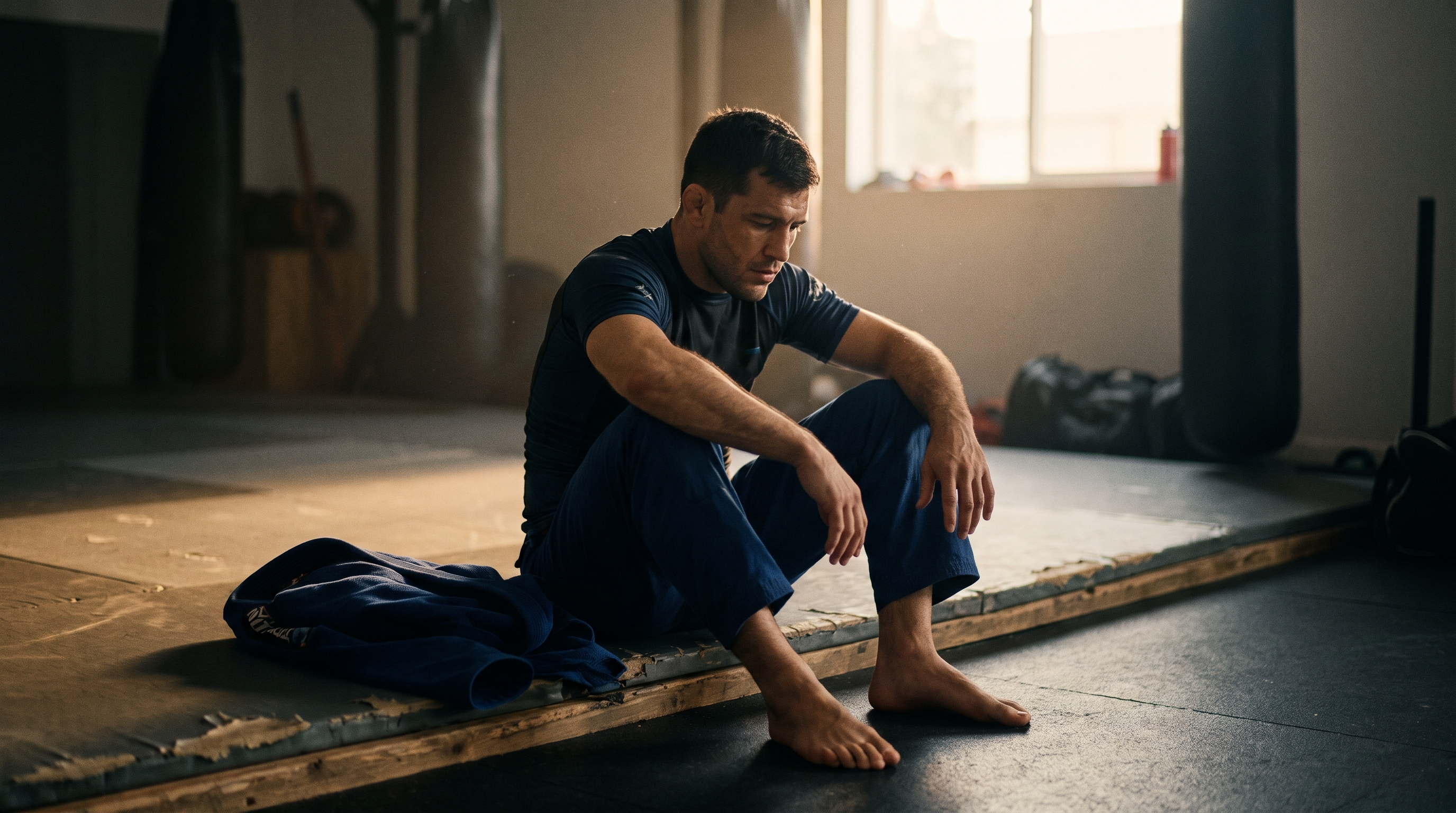
Pre-Competition Week: How to Review Your BJJ Game Plan Without Overtraining
TL;DR. The final week before a BJJ tournament is not the week to add new techniques or grind hard rounds. It's the week to taper volume, drill your A-game, review your positional decisions, and protect your sleep. This guide gives you a day-by-day framework for competition week: lighter mat time, shorter smart drilling sessions, mental rehearsal, weight management, and a pre-match warm-up. The goal is to arrive rested, confident, and clear on the two or three sequences you actually plan to hit.
A tournament is not won in the last seven days. It's won across the months of training that got you there. What competition week can do is preserve — or waste — that work. Most competitors we talk to make the same mistake: they train harder the closer they get to the event, hoping to squeeze in one more detail, one more takedown, one more sharp round. Then they walk onto the mat sore, tired, and mentally scattered.
The better move is a proper BJJ competition week prep: a taper, a focused review of your game plan, and a calm, repeatable routine you can trust when your name gets called.
Key takeaways
- Cut training volume in the final week but keep short, sharp technical sessions so your timing stays intact.
- Review, don't rebuild — the week before a tournament is for reinforcing your existing game, not learning new positions.
- Build your game plan around a small number of high-percentage sequences from your best position, guard, and takedown.
- Protect sleep, hydration, and appetite; recovery quality matters more than one extra hard round.
- Do mental rehearsal daily: visualize starting positions, transitions, and how you respond when things go wrong.
- Cap live rolling by mid-week and finish the week with flow rolls or positional sparring at controlled intensity.
- Have a written warm-up and match-day routine so nothing on tournament morning is improvised.
Why competition week is a review week, not a peak week
The strength and conditioning world calls this a taper. In BJJ we don't taper as aggressively as a marathon runner, but the principle is the same: right before the event, you reduce volume while keeping some intensity and specificity, so the body arrives fresh but the neuromuscular patterns stay switched on.
What that means in plain terms:
- You still train, but less.
- You still go hard sometimes, but for shorter blocks.
- You focus almost entirely on what you already do well.
This week is not the time to fix a hole in your side control escapes or learn a new guard. Those are pre-camp jobs. If you can't do it fluently by Monday of competition week, it doesn't exist for this tournament. Trust the game you have.
Remember. Adding new techniques in the final week rarely helps and often hurts. It creates hesitation on the mat — the worst possible mental state under a referee and a clock.
Building the review — your A-game in three positions
Before you touch your schedule, sit down and write out your game plan on one page. Don't overthink it. You're looking for a small, honest inventory of what you actually hit against resisting partners.
Structure it around three phases:
- Standing / start of the match — one preferred takedown or guard pull, plus a backup.
- Top game — one pass you trust, one submission chain from a dominant position.
- Bottom game — one guard you play, one sweep, one submission from that guard.
That's it. Six to eight techniques, chained. If you look at your written page and it has fifteen entries, you're bluffing yourself. Cut it down.
A useful test: for every technique on the sheet, ask "When did I last hit this on a resisting training partner my level or above?" If the honest answer is "months ago" or "only in drilling", it's not on your competition sheet.
Once your one-pager is written, competition week becomes simple: everything you do on the mat and in your head reinforces that one page.
A realistic competition-week schedule
Every competitor is different — belt level, day job, weight cut, injury history. Use the table below as a template and adjust to your reality. If you train five days a week normally, don't try to suddenly train seven this week. If you train twice a week, don't panic-add three sessions.
| Day | Session | Focus | Intensity |
|---|---|---|---|
| Monday | Full class | Normal training, positional sparring only, no all-out rolls | Moderate |
| Tuesday | Short drilling (45–60 min) | Your A-game sequences, both sides | Low–moderate |
| Wednesday | Full class | Last day of live rolling — controlled rounds with familiar partners | Moderate–hard |
| Thursday | Rest or 20-min movement | Mobility, light flow, no partner sparring | Very low |
| Friday | Short drilling (30–45 min) | Warm-up sequence + one pass, one sweep, one submission | Low |
| Saturday | Rest / mental rehearsal | Weigh-in check, visualization, sleep priority | Rest |
| Sunday | Tournament | Follow your warm-up and match routine | Competition |
The two hardest days in this template are Monday and Wednesday. After Wednesday, the volume falls sharply. That's intentional. By Friday your body should feel light, not beaten up.
If your tournament is on Saturday instead of Sunday, slide everything back one day and take Thursday off completely.
What each session should actually contain
Positional sparring instead of all-out rolls
Early in the week, replace open rolling with positional starts that map to your game plan. Start from your guard and try to sweep. Start in side control and try to submit. Start standing and work your grip and takedown. Three-minute rounds, reset, next partner.
This gives you specific reps in exactly the situations you'll face on Sunday, without the random beatings that come from six-minute open rolls.
Solo drilling and shadow grappling
Ten minutes of shadow grappling — moving through your sequences with no partner — is one of the most underused tools in competition prep. It's zero injury risk, low cardiovascular cost, and it wires the movement patterns in.
Do it in the morning, in your kitchen, in flip flops. Feet, hips, hands. Move through your guard entries, your pass, your finishing details. Five minutes twice a day beats a single 30-minute block once a week.
Mental rehearsal
Sit down, close your eyes, and walk through a match in your head. Feel the grip. See the takedown attempt. Watch yourself pass, get to mount, finish. Then rewind and picture the match going badly — you get taken down, you get stacked, you're behind on points. Watch yourself respond calmly with a specific technique.
This isn't mystical. It's rehearsal. The mat feels less foreign on match day because your brain has already been there.
Remember. Confidence on competition day comes from clarity, not from cramming. If you can describe your first thirty seconds of the match out loud in detail, you're in a good place.
Recovery: the boring part that wins matches
The last week is when recovery beats training. In order of priority:
- Sleep. Protect it. Go to bed at a consistent time. If you're cutting weight, this becomes even more important.
- Food. Eat what you know sits well with you. Competition week is not the time to try a new diet, a new supplement, or a restaurant you've never been to.
- Hydration. Steady water intake through the week. If you're making weight, follow a plan you've already tested — never improvise a cut.
- Mobility. Ten minutes of gentle mobility work daily keeps the body loose without adding fatigue.
- Stress management. Reduce non-essential commitments. Say no to things.
One small hard round on Tuesday will not save your tournament. One bad night of sleep on Friday can absolutely ruin it. Guard your recovery like you guard your neck.
Weight cut — only if you've done it before
A short honest note: if you have never cut weight before, your first tournament is not the time to start. Compete at your walking weight, learn how tournaments feel, then plan a cut for the next one with your coach.
If you are cutting:
- Know your target and hit it two to three days out, then rehydrate and refuel.
- Weigh yourself daily so nothing surprises you on weigh-in day.
- Don't sacrifice sleep or mat sharpness for a lower bracket.
A smart, moderate cut you've done before is fine. A panicked last-minute cut ruins performance, and sometimes health.
The night before and the morning of
Write these down. Do not improvise on tournament day.
Night before. Pack your bag (gi, backup gi if allowed, mouthguard, tape, water, food, whistle if needed, phone charger, snacks for after weigh-in). Check the venue address and travel time. Set two alarms. Go to bed early.
Morning of. Eat something familiar. Arrive early enough to see one or two matches from your bracket if possible. Hydrate slowly. Warm up before they call your name, not while they're calling it.
Warm-up. Ten to fifteen minutes: joint mobility, a light sweat, then rehearse your first sequence — grip, entry, first attack. You want to walk to the mat already breathing, already moving, already in the pattern.
After the tournament — how to maintain the sharpness
Win or lose, the week after the event is as important as the week before.
- Take a real rest. Two to five days completely off the mat. Sleep. Eat. Walk.
- Watch your matches. Film is the fastest coach you'll ever have. Note the moments things went well, the moments they didn't, and what specifically caused each.
- Update your game plan sheet. What actually worked under pressure stays. What didn't work gets studied, drilled, or dropped for next time.
- Return to training gradually. One or two lighter sessions before you jump back into hard rolling.
Most competitors either disappear from the gym for a month after a tournament or come back too hard and get injured. Neither serves your long-term progress. A short, deliberate reset is the move.
If you make a habit of writing down what worked and what didn't after every tournament, your game plan gets more honest — and more effective — every year. If you'd like a tidy way to keep those notes together with the video clips you review from your matches and from instructionals, that's exactly what BJJ Memo was built for. Save the sequences you're actually competing with as technique cards, and pull them up the week of your next tournament without hunting through YouTube tabs.
For more on organizing what you learn between events, see our guides on how to remember BJJ techniques and building a personal game.
A coach still beats an app
This article gives you a framework, but nothing here replaces a coach who knows you, your body, and your competition history. Talk to them before you copy any schedule word for word. If your coach says do more, do more. If they say do less, do less. They've watched you roll for years — an article hasn't.
Train the details at a legit academy with a qualified coach. Use tools like BJJ Memo to help you remember and revise between sessions. On tournament week, trust the work you've already done and let the taper do its job.
Frequently asked questions
How many days before a BJJ tournament should I stop hard rolling?
As a general rule, finish your last hard live rolling round about three to four days before you compete. For a Sunday tournament, that usually means Wednesday is your last hard session. After that, keep training light — drilling, positional starts, flow rolls — so your timing stays sharp without accumulating fatigue or picking up a last-minute injury.
Should I learn any new techniques the week before a tournament?
No. Competition week is for reinforcing your existing A-game, not for adding new material. New techniques create hesitation because you haven't done enough reps under resistance to trust them. Save the learning for after the tournament and compete with the game you already own.
What if I feel undertrained the week before my competition?
That feeling is normal and it's usually the taper doing its job — your body is finally recovering. Resist the urge to add sessions. Instead, do more mental rehearsal, review your game plan on paper, and trust the months of training behind you. Fresh legs and a clear head almost always beat sore legs and a foggy head.
How much should I sleep during BJJ competition week?
Aim for a consistent sleep schedule with as many hours as your body normally needs to feel well recovered, and prioritize the two nights before the event. If you can't sleep the night before because of nerves, don't panic — the previous nights matter more, which is why protecting sleep all week is smarter than hoping for one perfect night.
Should I cut weight for my first tournament?
Generally, no. If you've never cut weight, compete at your walking weight and learn how a tournament actually feels first. Weight cuts affect performance, recovery, and mood, and they should be planned and rehearsed with a coach. Save the cut for a later event once you understand your baseline.
What should my match-day warm-up look like?
Ten to fifteen minutes total: light movement to raise body temperature, joint mobility for hips, shoulders, and neck, then rehearsal of your opening sequence — grip fighting, your first takedown or guard pull, and your first attack. Finish warm, breathing, and mentally rehearsed. Do this before your name is called, not while the referee is looking for you.
Last updated 2026-09-17.