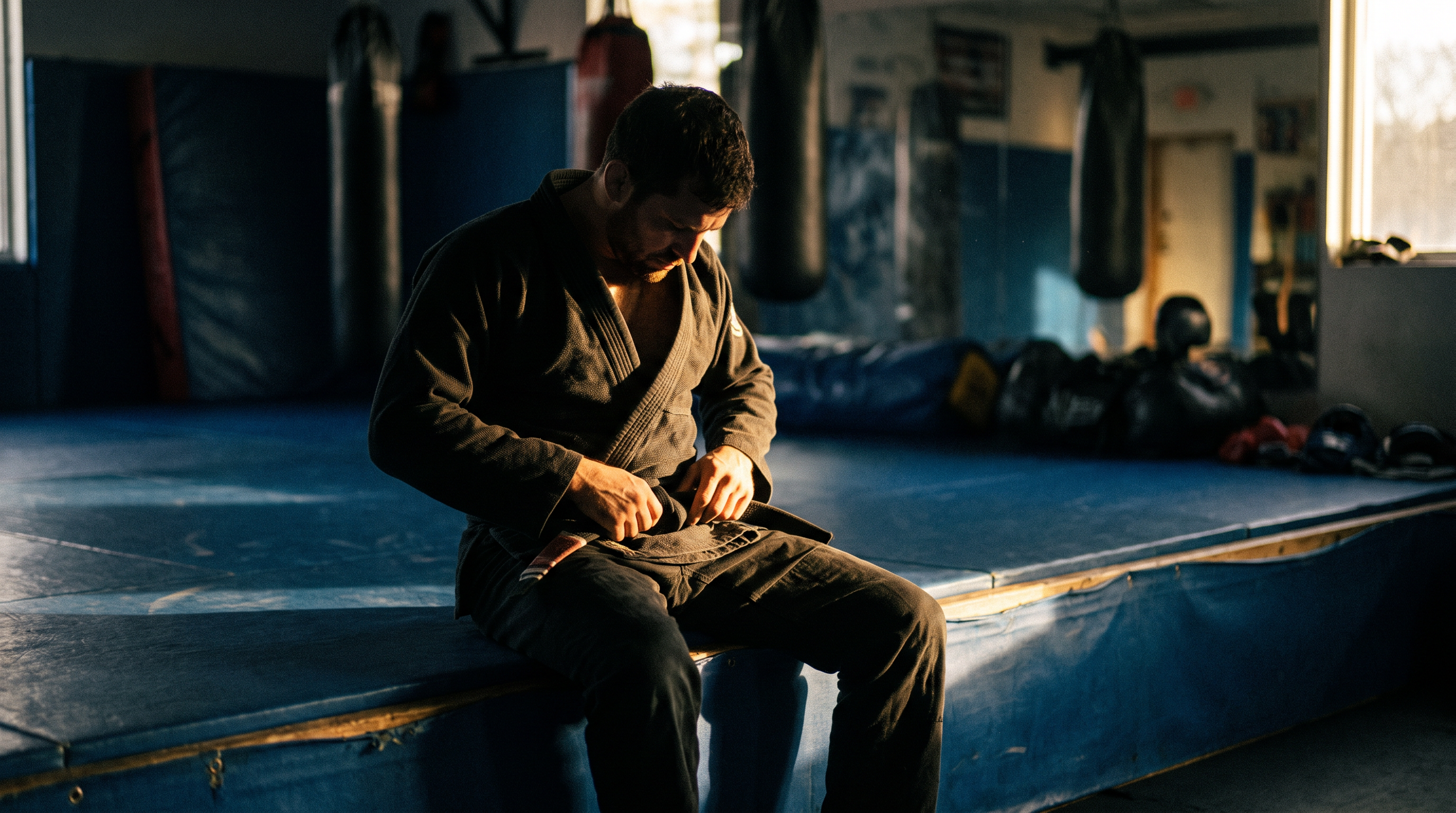
Pre-Tournament BJJ Taper: How to Sharpen Your Game the Two Weeks Before You Compete
TL;DR. The two weeks before a BJJ tournament are for sharpening, not building. Cut volume, keep intensity short and honest, drill your A-game, review your best techniques nightly, and protect your body from injury and illness. Sleep, food, weight and mental prep matter as much as mat time in this window. Use this two-week taper to arrive fresh, confident and ready to run your game — not gassed from over-training.
Key takeaways
- Volume comes down, specificity goes up: fewer rounds, sharper drilling, cleaner sparring.
- Stop learning brand-new techniques around 10–14 days out — refine what you already own.
- Any weight cut should be gentle and mostly done before fight week, never crash-style.
- Nightly technique review — notes, cards, or a notebook — is where the real "peaking" happens.
- Protect your body: skip risky spars, no ego rolls with the biggest partner in the room, no brand-new submissions.
- Treat sleep and food like part of your training plan, not an afterthought.
- Walk in with a written A-game map: your top guard, top pass, top submission, top escape.
Why the last two weeks matter more than the last two months
Your game was built over months and years. The final fortnight can't add anything meaningful to your technique library — but it can absolutely break you. Most competitors show up either flat (over-trained, injured, tired) or scattered (too many techniques in their head, no clear plan). A good pre-tournament BJJ taper solves both problems.
Think of the two-week window as three overlapping jobs:
- Sharpen — turn your best positions into automatic, on-demand tools.
- Recover — arrive on match day physically fresher than a normal training week.
- Clarify — walk onto the mat knowing exactly what you want to do from every position.
If a session doesn't serve one of those three, cut it.
Remember. Fitness gains from this week won't show up on tournament day. Fatigue, injuries and confusion absolutely will. When in doubt, do less.
Week 2 out (days 14–8): sharpen, don't rebuild
This is your last productive training week. Volume can still be close to normal, but the content changes.
Drill your A-game, not the whole art
Pick a short list — one top guard, one top pass, one top submission from your favorite position, one escape from your worst position. That's it. Drill those on repeat, with a resisting partner, from realistic entries. Your goal is not "know more"; it's "be faster and cleaner at what you already know."
Positional sparring over free rolling
Free rolling has its place, but positional sparring is a scalpel. Start from the exact positions you'll want to force on tournament day: your closed guard vs. a posture-heavy passer, side control top with 90 seconds on the clock, back control with hooks in. Reps under pressure > random rounds.
One hard session, then back off
Somewhere around day 10–8, do one honest, competition-style session — full rounds, tough partners, a match simulation. Then let it be your last hard day. Anything harder than that in the final week will cost you more than it gives.
Keep it clean
No new submissions you've never hit. No spinning heel hook experiments. No "let me try that thing I saw on YouTube last night." You have the rest of your BJJ life for that.
Week 1 out (days 7–2): taper, review, recover
This is where most competitors get it wrong. They panic about being "undertrained" and do too much. Trust the work you've already put in.
Cut volume, not sharpness
Shorter sessions. Fewer rounds. Slightly longer rest between rounds. Prioritize movement quality — you should leave the mat feeling loose, not shredded.
Flow rolling and specific starts
Replace grinding rounds with light flow rolls and short positional starts. The intensity dial is around 60–70% for most rolls, with only occasional short bursts to keep the nervous system sharp.
Nightly technique review
This is your secret weapon. Every night, spend 10–15 minutes reviewing your A-game: watch a short clip, read your notes, or flip through your saved technique cards. You're not trying to learn anything new — you're locking in what's already there. Our guide on how to remember BJJ techniques goes deeper into the review habit, and it matters more this week than any other week of the year.
Protect the body
No new stretches you've never tried. No sauna experiments. No new supplements. No shoes you haven't run in. Boring is good.
Remember. The best pre-tournament week feels almost too easy. If you're wrecked on Friday, you'll be wrecked on Saturday too.
The two-week taper at a glance
| Day | Focus | Session length | Intensity | Notes |
|---|---|---|---|---|
| 14 | Normal class + drilling | Full | Moderate–hard | Start narrowing to A-game techniques |
| 13 | Positional sparring | Full | Moderate | Top and bottom of your key positions |
| 12 | Rest or light movement | Short | Easy | Mobility, walks, stretching |
| 11 | Drilling + rounds | Full | Moderate | Match-length rounds |
| 10 | Hard simulation day | Full | Hard | Your last real "test" |
| 9 | Rest | — | — | Sleep, food, review notes |
| 8 | Light drilling | Short | Easy–moderate | Refine, don't grind |
| 7 | Positional starts | Short–medium | Moderate | Focus on your A-game entries |
| 6 | Flow roll | Short | Easy | Movement, timing, breathing |
| 5 | Rest or mobility | — | — | Weight in a comfortable range |
| 4 | Short drilling | Short | Easy | Your top 3 sequences only |
| 3 | Light movement | Short | Easy | Visualize matches |
| 2 | Rest | — | — | Pack bag, review cards, sleep early |
| 1 | Compete | — | All in | Trust the taper |
Treat this as a template, not a law. Adjust to your schedule, your body and your coach's plan.
Fight week habits: sleep, food, weight, mind
Sleep
Sleep is the cheapest performance upgrade in grappling. Move bedtime earlier by 30–60 minutes across the week. Two great sleeps in the last 48 hours matter more than one perfect night before you compete — because nerves usually eat that last night.
Food
Eat the way you normally eat. Fight week is not the week for a new diet, a cleanse, or your first-ever keto experiment. Stay hydrated. Keep meals familiar, easy to digest, and on your normal schedule.
Weight
If you're cutting, most of it should be done by the start of fight week. Small, gentle adjustments — water, salt, fiber — beat crash cutting every time. Cutting hard in the last 24 hours will drain the two weeks of taper you just spent building.
Mind
Spend a few minutes a day quietly running matches in your head: your grips, your entries, what you do if they stall you, what you do if you're down on points with a minute left. Visualization is not woo — it's a rehearsal of the exact decisions you'll be making on the mat.
Remember. You don't rise to the level of your ambition on match day. You fall back on the level of your habits. The taper is where you protect those habits.
Your A-game map: write it down
Before you leave the house on tournament day, you should be able to fill in a page like this without thinking:
- Standing: my grip strategy, my go-to takedown, my guard pull plan.
- Top: my #1 pass, my back-up pass, my pressure spot.
- Bottom: my primary guard, my main sweep, my main submission entry.
- Escapes: my mount escape, my side control escape, my back escape.
- Score situations: what I do if I'm up 2, down 2, or tied with 60 seconds left.
If you keep your notes and clipped instructionals in one place — your notebook, your phone, your BJJ Memo library — this becomes a 15-minute review the night before instead of a panic. Our post on how to study BJJ instructionals walks through building that library in the weeks leading up to a competition.
After the tournament: keep what you learned
The most valuable part of competing is the review that follows. Within a day or two, while the memory is fresh:
- Note the positions you handled well and the ones that surprised you.
- Flag one technique your opponent used on you that you want to learn.
- Flag one A-game move that didn't work — and ask why it didn't work.
- Rest actively for a few days (walks, mobility, light drilling) before returning to hard training.
Those notes become the training focus for the next block. That's how competitors compound — every tournament makes the next preparation smarter, not just harder. See our blog for more on turning matches and instructionals into a personal technique database.
A short word on safety
For real feedback — on your weight cut, your game plan, and how hard to push in the final week — train with a qualified coach at a legit academy. This guide is a framework, not medical or coaching advice. If something hurts or feels off, back off and talk to your coach and a healthcare professional.
Frequently asked questions
How many days before a BJJ tournament should I stop training hard?
Most competitors do their last genuinely hard session around 5–7 days out, and taper into shorter, lighter work from there. Some do their last hard round even earlier. The exact number matters less than the principle: no session in the final week should leave you sore, banged up or exhausted the next day.
Should I stop rolling completely the week before a BJJ competition?
Usually no. Complete rest for a full week often makes people feel flat and slow. Instead, drop volume and intensity: shorter rounds, flow rolling, positional starts, and focused drilling. You still want the nervous system to feel the timing of a live opponent — just without the wear and tear.
Can I learn a new technique in the last two weeks before a tournament?
It's better not to. New techniques take weeks or months to become reliable under pressure. In the final two weeks, focus on refining what you already do well. Save new material for the training block after the tournament, when you can drill it properly without pressure.
How do I cut weight for a BJJ tournament without wrecking my taper?
Gentle and early. If you need to cut, most of the drop should happen in the weeks before fight week, using small daily adjustments to food and hydration. Extreme last-minute cuts (long saunas, water loading experiments, starvation) will erase most of the freshness your taper built. When in doubt, compete a division up.
What should I do the night before I compete?
Eat a familiar meal, review your A-game map or technique notes for 10–15 minutes, pack your bag, and get to bed early. Don't watch three hours of highlight reels of your opponent's teammates. Don't try new stretches. Boring, calm and early is the goal.
How do I calm nerves on tournament morning?
Use routine. Same breakfast you'd eat before a hard training session. Same warm-up you've used for weeks. Slow, long exhales between matches. Remind yourself that nerves mean the fight matters — not that you're unprepared. Trust the two weeks of work you just did.
Sharpen the taper with better review
The difference between a chaotic competition camp and a clean one usually isn't more mat time — it's better review. Save the videos, clips and class notes that shaped your A-game, turn them into structured technique cards, and revise them in the two weeks before you compete. That's exactly what BJJ Memo is built for: capture a technique from any BJJ YouTube video, file it into your personal library, and pull it up for a two-minute review before every session in fight week.
Build your library once, and every future tournament taper becomes a matter of pressing play on the game you already own.
Last updated 2026-09-03.