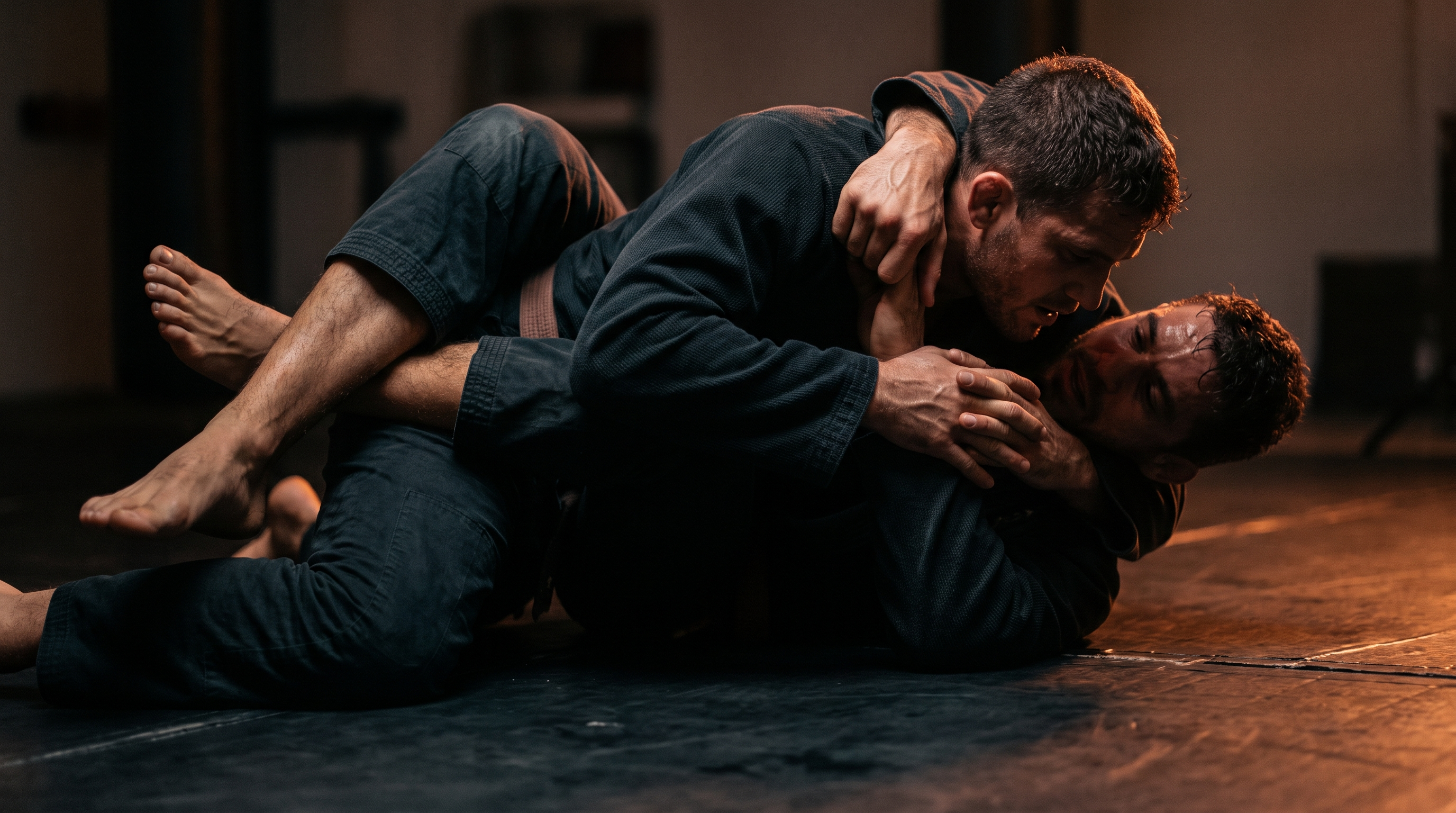
Rear Naked Choke Fundamentals: How to Actually Finish It Every Time
TL;DR. The rear naked choke fails for most grapplers because they attack the neck before they own the position. Lock in a tight seatbelt with your chest glued to their upper back, kill their internal hand, then feed your choking arm under the chin — not across the jaw. Finish with a shoulder-to-shoulder connection, elbows squeezing in, and your head pressed against theirs. Do this in order, every rep, and the RNC becomes the highest-percentage submission in jiu-jitsu.
The rear naked choke (RNC) is often called the most reliable submission in Brazilian Jiu-Jitsu, and for good reason: it works in the gi, no-gi, MMA, and self-defense, and it does not depend on flexibility, strength, or a specific body type. If you can get to the back and finish clean, you have a submission that scales from white belt to world champion.
And yet, most beginners and even mid-level blue belts lose the RNC constantly. They take the back, they get the seatbelt, they even feel the neck exposed — and somehow the opponent escapes, spins in, or peels the arm off. The problem is almost never the choke itself. The problem is the order of operations and the small details that never quite get drilled properly. This guide breaks the RNC down into the fundamentals you can actually apply on the next roll.
Key takeaways
- The rear naked choke is a position-first submission — if the back control breaks, the finish breaks with it.
- A proper seatbelt grip (one arm over the shoulder, one under the armpit) is the base of every RNC setup.
- Kill the opponent's internal hand first; without hand-fighting, the choke rarely lands cleanly.
- Feed the choking arm under the chin, not across the jaw or mouth, to isolate the carotid arteries.
- The finish is a squeeze, not a pull — elbows in, shoulders together, head pressed against theirs.
- Angle matters: dropping to the side of the choking arm removes their defensive frame.
- Reviewing the small details between sessions is what turns the RNC from a lucky tap into a reliable finish.
Why this happens: the real reason your RNC keeps slipping
The RNC is a choke, but the setup is a wrestling and positional problem. Most missed finishes trace back to one of three root causes, and once you name them honestly, you can start fixing them.
1. You are chasing the submission before you own the position. The classic sign is a loose seatbelt, feet dangling off the hips, and one hand already digging for the neck. If your hooks are shallow, your chest is off their back, or your seatbelt is loose, the choke will never land — they will simply spin, shrug the choking arm off, or hip-escape out the back door.
2. You are ignoring the internal hand. The opponent has two hands. The dangerous one is the hand on the same side as your choking arm — the "internal hand" that will peel your forearm away from their neck. If you do not control that hand, they will strip the choke every time.
3. You are attacking the jaw, not the neck. A rear naked choke is a blood choke — it works by compressing the carotid arteries on the sides of the neck, not by crushing the windpipe or grinding the jaw. If your forearm rides up onto the chin, they can tuck, they can bite, and the choke stalls.
Everything in the system below is designed to remove these three failure modes in order. Position, hand-fight, choke.
A simple system: 6 steps to a reliable rear naked choke
Use this sequence on every rep, in every roll, until it becomes automatic. It is intentionally boring — that is what makes it work.
1. Own the back before you touch the neck
Before you even think about the RNC, verify the back control checklist:
- Both hooks in (or a body triangle, if you prefer).
- Chest glued to their upper back — no daylight between you.
- Seatbelt locked: one arm over the shoulder, one arm under the armpit, hands connected (usually a hand-in-hand grip or a wrist grip).
- Your head on the side of your over-shoulder arm, biting down to prevent them from bridging you into mount.
If any of these are missing, do not chase the choke. Fix the position first.
2. Establish the choking-arm side
Your choking arm is the arm that is over their shoulder. This is important: many beginners try to reach across with the underhook arm and end up cross-collar style, which telegraphs the attack and gives away the back. Commit to the over-shoulder arm as your choking arm.
3. Kill the internal hand
The internal hand — same side as your choking arm — is the biggest threat to your finish. Common ways to neutralize it:
- Use your underhook-side hand to trap their wrist against their own chest or hip.
- Feed their wrist across to your choking hand momentarily, freeing your other hand to work.
- Stuff their hand between their own thigh and your leg using a body triangle.
Once that internal hand is dead, they cannot peel the choke.
4. Feed the choking arm under the chin
Slide your choking hand up their sternum, along the centerline of their chest, and under the chin. Aim your thumb toward the far ear. Two details separate the pros from the strugglers:
- Palm up, elbow low. A palm-down feed usually rides up onto the jaw.
- Deep bite. Your elbow should end up under their chin, on the centerline, with your bicep on one side of their neck and your forearm on the other.
If the chin is glued down and you cannot get under, do not force it. Use a hand or your own choking-hand knuckles to lift the chin (the "can-opener" concept, used briefly and legally as a lifting mechanic in no-gi), or attack a collar, lapel, or bow-and-arrow variant instead.
5. Build the frame: hand behind the head
Bring your non-choking hand up and place your palm on the back of their head, fingers pointing toward the ceiling. Then connect your choking hand to your own bicep. The classic grip:
- Choking-hand palm slaps into your own bicep.
- Free hand behind the head, elbow tight.
This is the geometry that turns a neck grab into an actual choke.
6. Finish with a squeeze, not a pull
The finishing action is subtle. You are not yanking the head back. You are:
- Bringing both elbows toward each other (shoulders-to-shoulders).
- Expanding your chest so your shoulder blades pinch.
- Pressing your head against theirs so they cannot posture forward.
- Slightly rotating to the choking-arm side so their spine tilts away from their defensive hand.
Done correctly, the tap comes quickly and quietly. If you are red in the face and grinding for ten seconds, something in steps 1–5 is off.
Remember. The RNC is a squeeze, not a pull. If you are cranking on the neck, you are probably grinding the jaw and burning your grip. Reset the details.
Common mistakes (and the quick fix)
| Mistake | What goes wrong | Quick fix |
|---|---|---|
| Loose seatbelt | Opponent shrugs the choke off | Reconnect hands, chest to upper back |
| Choking arm across the jaw | No artery compression, they defend forever | Feed lower, palm up, elbow to centerline |
| Ignoring the internal hand | They peel your forearm | Trap wrist first, then feed |
| Feet off the hips | You get bucked into mount reversal | Reset hooks or switch to body triangle |
| Pulling with the arms | Grip gasses out, no tap | Squeeze elbows together, press head-to-head |
| Choking hand palm-down | Rides up onto the chin | Feed palm-up, thumb to their far ear |
| Head on the wrong side | Rolled into bottom mount | Head on the over-shoulder side, bite down |
Most of these show up in every training session at every academy. The good news: they are all fixable with attention, not talent.
Remember. Position first, hand-fight second, choke third. Skip a step and the RNC becomes a coin flip.
Where BJJ Memo fits in
If you have ever watched a great RNC breakdown on YouTube — Gordon Ryan on the seatbelt, John Danaher on the internal hand, Lachlan Giles on angle — and then completely blanked on the details three days later on the mat, that is normal. Passive watching does not build recall.
BJJ Memo is built for exactly this problem. Paste a BJJ YouTube URL — for example, an RNC deep-dive — and the app turns it into a structured Technique Card with clear steps, key details, and tappable timestamps for the important visual moments. You file it into your personal library, and before your next session, you flick through the cards you want to work. The details stay in your head where they belong: on the mat. It is a helper for retention, not a replacement for coaching or drilling.
Frequently asked questions
Is the rear naked choke a blood choke or an air choke?
Done correctly, it is a blood choke — your bicep and forearm compress the carotid arteries on either side of the neck, briefly restricting blood flow to the brain. That is why a proper RNC taps opponents quickly and painlessly. If it feels like you are crushing their windpipe, your forearm is riding up onto the jaw or throat and the finish will be slower and less reliable.
Can I finish the rear naked choke without hooks?
Yes, but the position must still be controlled. A body triangle, a leg hook, or even a strong seatbelt with chest pressure from turtle can all work as anchor points. What you cannot do is finish without controlling their hips and upper body — otherwise they simply spin out.
How long should it take to tap someone with a clean RNC?
With proper geometry and no gap on the neck, a blood choke usually forces a tap within seconds once fully locked in. If you find yourself squeezing for ten or fifteen seconds, you almost certainly have a small detail wrong — most often the choking arm on the jaw, or a loose grip on the bicep.
What is the safest way to drill the RNC in training?
Drill the entry, grip, and squeeze slowly with a cooperative partner and tap early. Never use the RNC to "prove a point" in rolling — release the moment your partner taps, verbally or physically. For real feedback and safety, drill and pressure-test at a legit academy with a qualified coach; an app or article can supplement your learning, not replace mat time.
Why do I keep losing the back before I can finish?
Usually because the seatbelt is loose, the hooks are too high on the thighs instead of the hips, or the head is on the wrong side. The RNC is a position-first submission — fix the back control checklist and the finish becomes much easier.
Should I focus on the RNC as a white belt?
Absolutely. The rear naked choke is one of the highest-percentage submissions in jiu-jitsu and it will stay in your game for the rest of your career. Getting the fundamentals clean early — seatbelt, internal hand, palm-up feed, squeeze — pays off at every belt level.
Take it to the mat
The rear naked choke rewards patience and clean details, not brute force. Own the back, kill the internal hand, feed under the chin, and squeeze — in that order, every time. Next time you watch an RNC instructional or a competition breakdown, save it as a Technique Card in BJJ Memo so the details are one tap away before your next roll. Build your own technique library and use the review flow to revise the small details between sessions — that is how the RNC stops being a lucky finish and starts being your finish. BJJ Memo is available on iOS and Android.
For real feedback and safety, train the technique at a legit academy with a qualified coach — BJJ Memo helps you remember and revise, it doesn't replace mat time.
Last updated 2026-08-22.
status: pending_review
risk_score: low
voice_check_passed: true
religious_check_passed: true
safety_check_passed: true
persona_targeted: white-and-blue-belts-learning-from-video