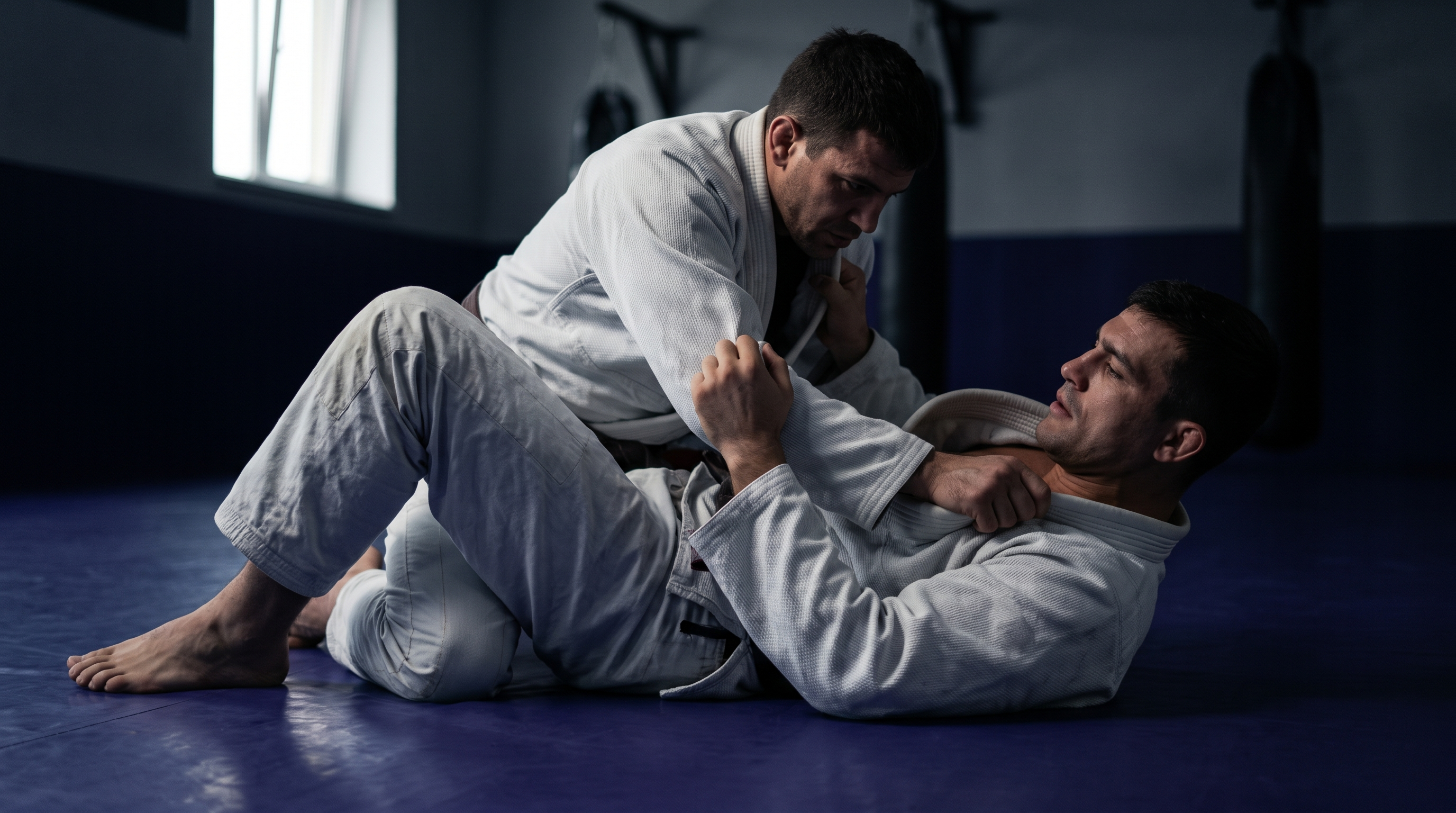
Scissor Sweep from Closed Guard: The First Sweep Every White Belt Should Actually Land
TL;DR. The scissor sweep is the first sweep most white belts learn — and the first one they stop trusting. It fails not because the technique is bad, but because beginners skip the setup: no angle, no off-balance, no grip control. This guide breaks down the sweep step by step, explains exactly why yours keeps missing, and gives you a checklist to revise before your next roll. Learn the mechanics here, drill them in class, and treat the scissor sweep as a doorway into the rest of your guard game.
Ask any blue belt what the first sweep they ever learned was, and most of them will say the same thing: the scissor sweep from closed guard. It's on day one of nearly every beginner curriculum in the world. It's also the sweep white belts quietly stop attempting after a few months, because it "never works" in rolling.
Here's the honest truth: the scissor sweep works. Instructors like John Danaher, Gordon Ryan and Lachlan Giles still hit versions of it. Your issue is almost certainly not the sweep itself — it's the sequence of tiny setups that make it possible. In this guide, we'll walk through the mechanics, the reason your version keeps failing, and a simple system you can actually remember on the mat.
Key takeaways
- The scissor sweep works on the diagonal, not straight back — you need an angle before you sweep.
- Kuzushi (off-balancing) comes first: break your partner's posture and load their weight onto one knee before you scissor.
- The "scissor" is your knees crossing like scissor blades — one knee cuts across their belt line, the other leg chops low at their knee.
- Grips matter more than leg power: a strong sleeve-and-collar grip controls their posting arm and steers their upper body.
- The sweep usually fails because the bottom player stays flat, keeps a square angle, and pushes instead of pulling.
- Drilling the entry (hip escape → angle → knee shield) is more valuable than drilling the finish.
- You don't need strength to sweep a bigger training partner — you need timing and a broken base.
Why your scissor sweep keeps failing
Most white belts learn the scissor sweep as a static, four-count drill: grips, knee across, other leg chops, sweep. So when they try it live and the top player just posts a hand and stays upright, they assume the technique is broken.
It's not. The scissor sweep is a reaction to a broken base, not a way to break the base itself. If your partner is already posted, upright and square to you, no amount of scissoring is going to tip them. You have to build the position first.
Here are the real reasons your scissor sweep keeps failing:
- You're square, not angled. Your hips are still pointing straight up at the ceiling. To sweep to the side, you have to first turn your hips to face that side.
- Your partner still has posture. If they're sitting upright with a straight spine, their base is huge. You need to pull them down and forward first.
- Your grips are weak or wrong. A limp sleeve grip won't steer anyone. You need a deep sleeve grip and a strong same-side collar grip.
- You're pushing them away. Beginners often push with the top leg like a leg press. The sweep is a pull-and-tip, not a push.
- No knee shield. Your top knee needs to be a wedge across their belt line, not floating in the air.
- You never load their weight. If their weight isn't already tilting over the knee you're going to chop, nothing will happen.
Remember. The scissor sweep isn't a leg movement. It's a full-body redirection of an off-balanced opponent. If they're still based, you're not ready to sweep yet.
A simple system: the scissor sweep in 6 steps
Here is a clean, minimal sequence that works from standard closed guard in the gi. Learn it in this order — don't skip steps just because the last one is the "cool" part.
1. Establish the grips
From closed guard, take a deep same-side sleeve grip (your right hand on their right sleeve, at the cuff) and a cross-collar grip (your left hand deep into their collar, thumb inside). These two grips together let you steer both of their arms and their posture.
2. Break their posture
Use the collar grip to pull them down and forward, and use your closed legs to pull their hips into you. You want their chest closer to your chest. A posted, upright opponent cannot be scissor-swept. A folded, forward-leaning opponent is one adjustment away from tipping.
3. Open the guard and shrimp to an angle
Unhook your ankles. Post on your near foot and shrimp your hips out toward the sleeve-grip side. Your body should now be angled — imagine your spine turning from 12 o'clock to about 10 or 2 o'clock, depending on the side. This is the step 90% of white belts skip.
4. Build the knee shield
Bring your top knee (same side as the collar grip) across their belt line, so your shin is like a bar across their stomach. Your bottom leg drops low and flat, foot near their knee on the other side. Now your legs are literally shaped like open scissors.
5. Load their weight and chop
Pull hard on the sleeve and the collar toward the mat on the sweeping side. You want to feel their weight tip over the leg you're about to chop. As they lean, chop your bottom leg into their knee/shin and lift with your top knee across their body. The two forces meet in the middle — that's the scissor.
6. Follow through to mount
Do not stop when they tip. Keep pulling with your grips, come up on your bottom elbow, then your hand, and ride the momentum all the way up into mount. A sweep that lands you back in guard is worth 0 points and 0 dominance.
Remember. Grips → posture → angle → knee shield → load → chop → mount. If any step is missing, the sweep won't land clean. Missing a step isn't a personal failing; it's a checklist you can fix.
The scissor sweep at a glance
| Step | What you do | What you're looking for |
|---|---|---|
| 1. Grips | Sleeve + cross-collar | Both of their arms controlled |
| 2. Posture | Pull them forward and down | Their chest closer to yours |
| 3. Angle | Shrimp your hips to one side | Spine no longer square |
| 4. Knee shield | Top knee across belt line | Shin wedged across their torso |
| 5. Load | Pull grips toward the mat | Their weight tips over your bottom leg |
| 6. Chop + follow | Scissor legs, ride the sweep up | You end in mount, not back in guard |
Common mistakes (and quick fixes)
- Staying square. Fix: shrimp before you scissor. Your top knee cannot cross their body if your hips are still facing straight up.
- Weak grips. Fix: kill the sleeve. Pinch it against your own body if you have to. If you lose the sleeve, the top arm posts and the sweep dies.
- Pushing with the top leg. Fix: think "lift and lead," not "press." The knee shield guides them; the pull with your arms does the actual tipping.
- Sweeping into empty space. Fix: sweep toward where their weight already is. If they're leaning right, sweep them right. Don't fight physics.
- Losing the sweep at the end. Fix: follow with your grips. Keep the sleeve pinned to the mat so they can't post their arm and stop your mount ride-up.
- Trying it on a based, defensive opponent. Fix: if your partner is turtled up and posted, chain to another attack — a hip bump sweep, an armbar, or a triangle. The scissor is a posture-and-angle sweep. If those aren't there, use something else.
Remember. Every failed sweep is data. Note which step broke — was it the grip, the angle, or the finish? — and revise it specifically next class. Vague reflection produces vague improvement.
Drilling vs. rolling: how to actually get good at this
A lot of beginners drill the scissor sweep by cycling reps of the finish and never touching the setup. That's why it works in drilling and dies in sparring.
Spend most of your reps on the entry:
- 1 minute: grip → posture break → shrimp to angle. Reset. Repeat.
- 1 minute: from the angle, build the knee shield and load their weight. Stop before the finish. Reset.
- 1 minute: full sweep to mount, slow and correct.
- Then and only then: positional sparring from closed guard with the scissor sweep as your primary attack.
This is also where studying instructionals matters. Watching a Lachlan Giles or Kent Peters breakdown of guard basics can rewire how you understand the setup — but only if you actually revise it before class. Passive video-watching does very little; structured notes and revision do a lot.
Where BJJ Memo fits in
If you're serious about learning the scissor sweep — and everything after it — the bottleneck usually isn't finding good content. It's remembering it. You watch a great breakdown on Sunday and by Wednesday's class most of the details are gone.
BJJ Memo is built for exactly that gap. Paste a BJJ YouTube URL (a scissor sweep breakdown, a Danaher lecture, a competition analysis) and the app turns it into a structured Technique Card — clear steps, key details, and tappable timestamps for the important visual moments. Cards are saved to a personal, searchable library on your phone, and a review flow surfaces them again before your next session.
For a sweep like this one, that means the six-step checklist above is in your pocket, not lost in a notebook. Explore more beginner guides or check the homepage to see how it works.
Frequently asked questions
Is the scissor sweep good for competition, or only for beginners?
It's both. The scissor sweep is a foundational sweep taught to white belts, but the same mechanics — off-balancing, angling, knee shield, chop — appear in higher-belt guard games all the time. What changes is the setup and the chains around it, not the core movement.
Why does my scissor sweep work in drilling but not in rolling?
Because drilling almost always skips the two hardest steps: breaking posture and creating an angle. In drilling your partner cooperates by leaning forward. In rolling they sit up, base out, and stay square. You have to earn the setup live before the sweep is available.
Do I need to be strong to land a scissor sweep on a bigger partner?
No. If you off-balance them correctly, their own weight does the tipping. If you find yourself grinding to muscle a bigger partner over, that's a signal your setup is missing a step — usually the angle or the posture break — not that you need to lift more in the gym.
Does the scissor sweep work in no-gi?
The gi version relies heavily on sleeve and collar grips. In no-gi, the same concept exists but you'll use underhooks, wrist grips or 2-on-1 controls to steer the upper body, and often chain into other sweeps like the hip bump, flower sweep or a knee-shield sweep from half guard. The principle — angle, off-balance, scissor the legs — carries over.
What should I chain to when the scissor sweep fails?
If they post their far arm hard, the arm is often exposed for an armbar. If they base their far hand on the mat, the triangle can open up. If they post their near hand, the hip bump sweep to the other side often works. A failed scissor sweep is not a dead end — it's a setup for the next attack.
How long before it starts landing in live rolling?
Honestly, it varies. For most people, once they consistently remember to break posture and create the angle first, the sweep starts landing within a few weeks of focused practice. Focused is the key word — random reps for months will do less than deliberate drilling of the entry for a few weeks.
Wrap-up
The scissor sweep isn't a beginner trick you'll outgrow. It's a doorway into understanding guard: how to break posture, how to create angles, how to convert off-balance into position. Get the six steps in your head, drill the entry more than the finish, and treat every failed rep as information rather than failure.
And for real feedback and safety, train the technique at a legit academy with a qualified coach. BJJ Memo helps you remember and revise — it doesn't replace mat time or a good instructor.
Next time you watch an instructional on the scissor sweep, save it as a technique card in BJJ Memo so it's there before your next roll. Build your own library, revise before class, and let the details stick.
Last updated 2026-09-16.