Sit-Up Guard for Beginners: How to Post, Grip, and Sweep from a Simple Open Guard
TL;DR. Sit-up guard is one of the most beginner-friendly open guards in BJJ because it starts from a position you already know — sitting up. You post on one hand, grip a sleeve and an ankle, and use your legs to off-balance a standing or kneeling partner. From there, the two highest-percentage entries are the classic sit-up sweep (when they post their weight forward) and the technical stand-up (when they pull back). Master those two reactions and you have a real guard game as a white belt.
Most white belts learn closed guard first, get stuck when their partner stands up, and then have no idea what to do with their legs. Sit-up guard fixes that. It's an open guard that keeps you upright, active, and connected to your partner — instead of lying on your back hoping something works. This guide walks you through the exact posture, the three grips that anchor the position, a simple five-step system to sweep, and the mistakes that quietly kill the position before you even try. You don't need flexibility, athleticism, or a purple-belt understanding of leverage. You need one hand on the mat, one sleeve grip, and the willingness to sit up and stay engaged.
Key takeaways
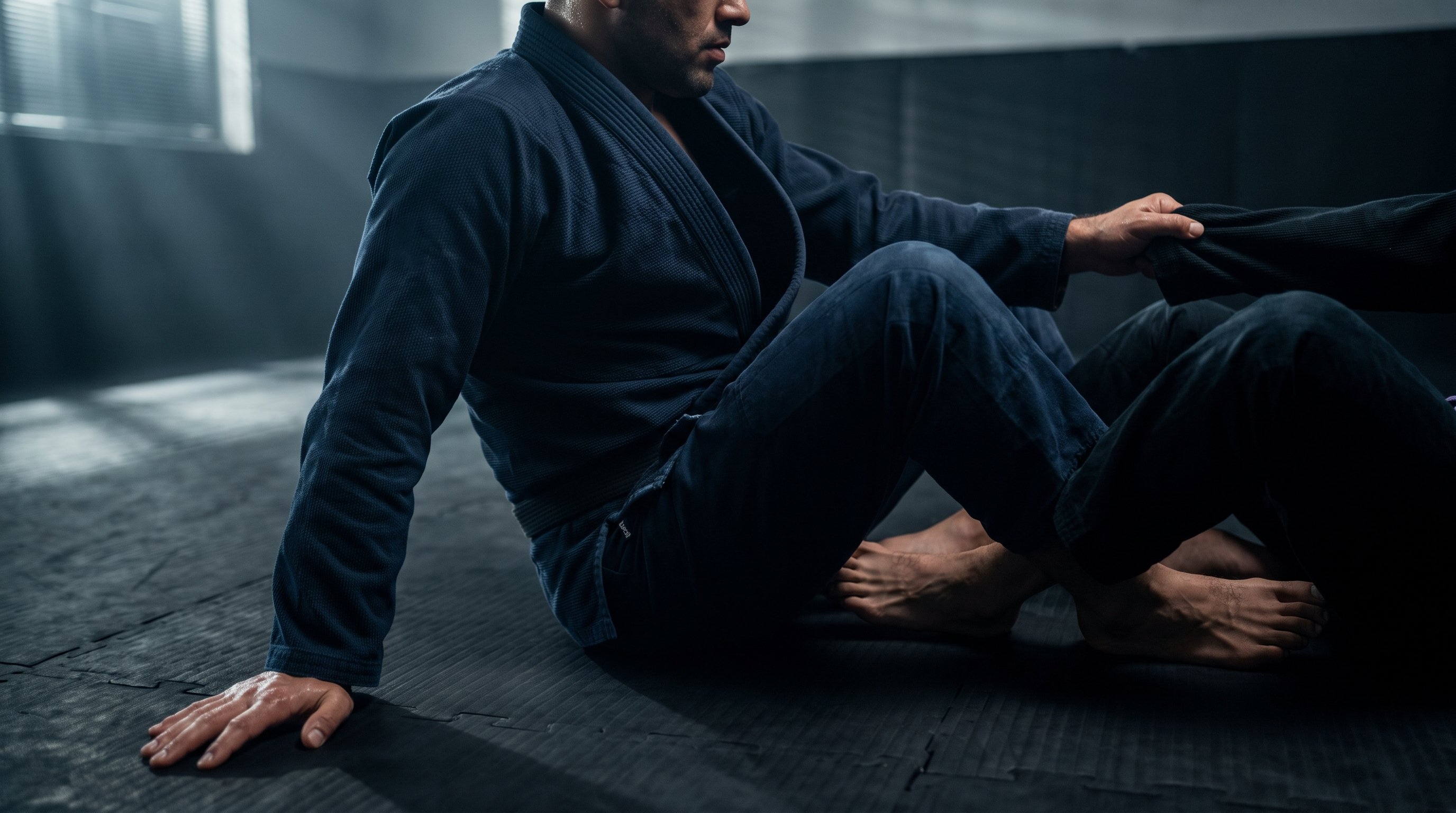
- Sit-up guard is an open guard where you sit upright with one hand posted behind you and your feet actively engaging your partner's hips, knees, or biceps.
- The three foundational grips are same-side sleeve, opposite-side ankle or pant, and your posting hand on the mat behind your hip.
- The sit-up sweep works when your partner's weight is forward; you clear the posting arm, drive your shoulder into their hip, and come up on top.
- If your partner pulls their weight back, transition to a technical stand-up instead of forcing the sweep.
- Beginners lose the position most often by lying flat, letting go of the sleeve grip, or trying to sweep without off-balancing first.
- Sit-up guard chains naturally into single-leg takedowns, X-guard entries, and the classic hip-bump sweep.
- Drill the movement pattern (post, sit up, load, sweep) slowly before adding a resisting partner.
Why sit-up guard works so well for beginners
The problem with lying flat under a passer is simple: you can't see, you can't push, and every movement your partner makes is unopposed. Closed guard hides this because your legs are locked around them. The moment your partner opens the guard and stands, most white belts collapse onto their back and get passed within seconds.
Sit-up guard flips that. You stay upright, your eyes are level with your partner's chest, and both of your arms are usable — one posting, one gripping. You're no longer waiting; you're playing. The posture is also biomechanically honest: it uses your hips and core the way a wrestler or judoka does, which means the strength and awareness you build here carry over to takedowns and scrambles.
There's also a psychological win. Beginners who learn sit-up guard tend to stop panicking when someone opens their closed guard, because they now have a place to go. That single change — having a next step — is often the difference between surviving a round and getting steamrolled.
Remember. Sit-up guard isn't a submission position — it's a control and off-balance position. Its job is to load your partner's weight onto a spot where they can't defend, then convert that into a sweep or a takedown.
A simple system: post, grip, sweep in 5 steps
Here's the whole position broken into a repeatable pattern. Drill this cold before you ever try it in a live round.
1. Sit up and post
From your back, sit up onto your near-side elbow, then straighten that arm so your palm is flat on the mat behind your hip. Your torso should be at roughly a 45-degree angle to the floor, not fully upright and not lying back. Your posting elbow stays slightly bent so it can act as a spring, not a locked pole.
2. Frame your feet on the hips
Both feet come off the mat and connect to your partner. The classic beginner setup is one foot on the near hip (the same side as your posting hand) and the other foot on the far knee or biceps. This four-point connection — one hand posted, one hand gripping, two feet engaged — is what makes the position stable.
3. Take the two key grips
With your free hand, grip your partner's same-side sleeve at the cuff. If you're in no-gi, grip the wrist. This grip does two jobs: it stops them from posting on you, and it gives you a lever to pull them forward. Your posting hand can shift to grip their ankle or pant cuff on the opposite side when you're ready to sweep.
4. Read their weight
Before you move, feel where their weight is. If they're leaning into you — trying to push you flat or pass — their weight is forward, and the sweep is on. If they're pulling back or standing tall, the sweep won't work; you'll need to stand up instead. This one-second read is what separates a functional sit-up guard from a spammy one.
5. Execute the sit-up sweep
When the weight is forward: pull hard on the sleeve to keep them from posting, drive off your posting hand, and shoot your same-side shoulder into the crease of their hip. Your posting hand comes off the mat and reaches across to hook behind their far knee or ankle. Finish by turning into them and coming up on top in combat base.
Quick reference: reading your partner's reaction
| Partner's reaction | What it means | Your response |
|---|---|---|
| Weight forward, posting on you | They're trying to smash-pass | Sit-up sweep |
| Weight back, standing tall | They're avoiding the sweep | Technical stand-up into single-leg |
| Circling to your posting side | They're trying to clear the leg | Switch to hip-bump sweep or shrimp out |
| Grabbing your posted arm | They're neutralizing your base | Rip the arm free, re-post on the other side |
Remember. The sweep is never a solo movement. It's always a reaction to your partner's weight. If they don't give you forward pressure, you don't force the sweep — you switch entries.
Common mistakes that kill sit-up guard
Most white belts don't lose sit-up guard because the technique is bad. They lose it because of small posture and grip errors that compound. Here are the ones to fix first.
Lying back instead of sitting up. The whole position depends on your torso being off the mat. The moment you lie back, your posting arm collapses, your grips weaken, and your partner can walk around your legs. If you feel yourself sinking, re-post immediately.
Letting go of the sleeve grip. The sleeve grip is what keeps your partner from stiff-arming you into the mat. Beginners often drop it to grab something else and then wonder why they got passed. Keep the sleeve grip until you have a better one locked in.
Posting on a soft hand. Your posting hand should be flat, fingers spread, palm pressing into the mat. A weak post — fingers pointed at your partner, or hand on its edge — will slip the moment you try to load weight through it.
Trying to sweep without off-balancing. The sit-up sweep is not a strength move. If you shoot your shoulder into your partner's hip while their weight is neutral, you're just pushing a heavy object. Pull the sleeve first, break their posture, then sweep.
Ignoring the technical stand-up. Sit-up guard has two answers: sweep them, or stand up. If you only know the sweep, a good partner will simply lean back and stall you out. Learning the technical stand-up is what makes the position a real threat.
Facing the wrong direction. Your shoulders should point at your partner, not at the ceiling. If your chest is facing up, you've turned sit-up guard into a bad butterfly guard.
How BJJ Memo fits into your sit-up guard practice
One of the reasons open-guard positions like sit-up guard take so long to click is that you learn them once in class, watch an instructional a week later, and by the time you roll on Thursday you've forgotten which foot goes where. BJJ Memo is built to solve exactly that gap. Paste a YouTube link to a sit-up guard breakdown — from your favorite instructor — and the app turns it into a structured technique card with the key steps, common mistakes, and tappable timestamps. You save it into your personal library, and before your next session you spend two minutes revising the card so the details are fresh when you tie up. It's not a replacement for drilling; it's the missing step between watching and remembering. Learn more at bjjmemo.com or browse the BJJ Memo blog for more beginner breakdowns.
Frequently asked questions
Is sit-up guard the same as butterfly guard?
No, but they're closely related. In butterfly guard, both feet are hooked inside your partner's thighs and you're usually more upright. In sit-up guard, one hand is posted on the mat and your feet frame on the hips or knees rather than hooking inside. Many players flow between the two depending on how their partner reacts.
Can I play sit-up guard in no-gi?
Yes. The mechanics are identical; you just swap gi grips for wrist grips and collar-tie style connections. Sit-up guard is actually one of the more gi-agnostic open guards, which is why it's a great first open guard to learn if you train both styles.
What if my partner is much bigger than me?
Sit-up guard rewards leverage over strength, but bigger partners can smash the position if you're passive. The key is to move first — off-balance them with the sleeve pull before they settle their weight. If they're stronger, use the technical stand-up more often; getting to your feet neutralizes a lot of the size gap.
How long does it take to get good at sit-up guard?
You can build a functional version — post, grip, and one working sweep — within a few weeks of focused drilling. Getting fluid with the reactions (sweep vs. stand-up vs. hip-bump) takes longer because it depends on reading your partner in real time, which only comes from mat hours. Consistent retention practice between sessions speeds this up noticeably.
Should I learn sit-up guard before closed guard?
Most gyms teach closed guard first, and that's fine — it builds the fundamental idea of controlling from your back. But sit-up guard should be the very next position you learn, because it's what you'll actually need the moment a partner stands to open your closed guard. Don't wait until blue belt to start.
What sweeps chain best from sit-up guard?
The hip-bump sweep is the most natural partner — same posture, similar grips, different finish. Beyond that, the single-leg takedown from the technical stand-up and the entry to X-guard are the two highest-percentage next steps for a beginner.
Start building your sit-up guard game
Sit-up guard is one of the best positions a white belt can invest time in because it teaches you the three things that matter most in open guard: posture, grip, and reading pressure. Drill the five-step pattern this week, add the sleeve grip as a habit, and start noticing which way your training partners lean. That awareness is the real skill; the sweep is just the finish.
Next time you watch a sit-up guard breakdown on YouTube, save it as a technique card in BJJ Memo so the details are there when you need them — before your next roll, not a week later when you've already forgotten. Available on iOS and Android.
Teacher disclaimer. This article is a written breakdown for learning and revision. For real feedback, timing, and safety, drill sit-up guard at a legit academy with a qualified coach. BJJ Memo helps you remember and revise techniques — it doesn't replace mat time or coaching.
Last updated 2026-09-25.