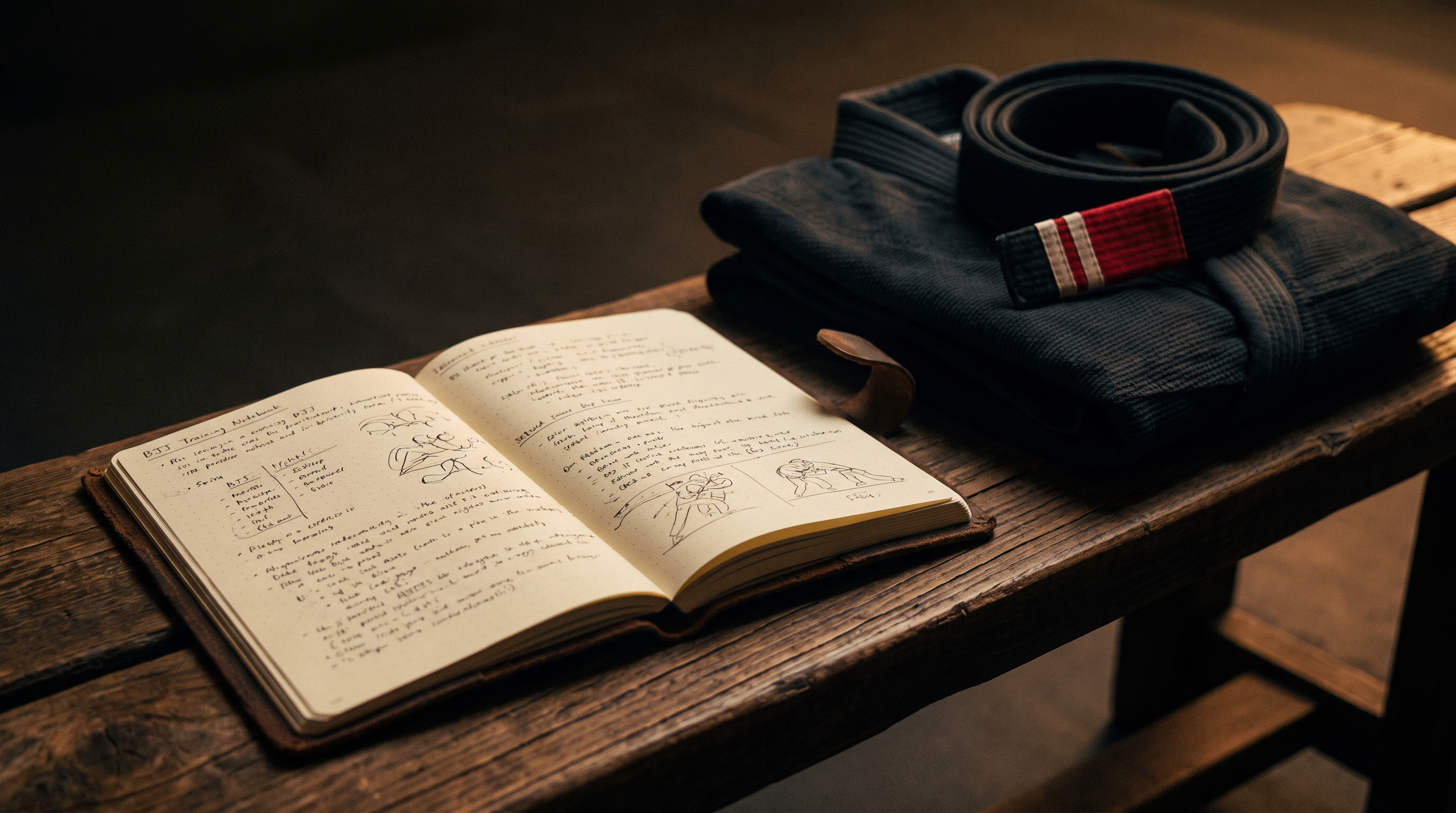
How to Remember BJJ Techniques Weeks Later: A Spaced Repetition Plan for Grapplers
TL;DR. Most BJJ techniques fade from memory because you see them once and never revisit them on a schedule. Spaced repetition — reviewing a technique at expanding intervals (roughly the same day, a few days later, a week later, a month later) — is the fix. Keep your notes short, tie each rep to a concrete detail, and drill the moves you review before rolling. This article gives you a simple 5-step system you can start after your next class.
Every grappler has lived this moment: your coach shows a beautiful sweep, you drill it a few times, it clicks, and by the next class you can't remember which grip came first. That gap between seeing a technique and owning it is where most training time quietly leaks away. You are not slow — you are asking your brain to hold on to detail it was never scheduled to review.
Spaced repetition is a study method used everywhere from language learning to medical school: instead of reviewing new material once, you revisit it at expanding intervals so it moves from short-term to long-term memory. Applied to BJJ, it turns messy weekly class notes into a personal technique bank you actually recall on the mat. This article walks through why grapplers forget, a five-step system you can start tonight, and the common mistakes that quietly kill retention.
Key takeaways
- You forget BJJ techniques because you learn them passively and never revise them on a schedule, not because you lack talent.
- Spaced repetition means reviewing a technique multiple times at expanding intervals so it moves from short-term to long-term memory.
- A workable BJJ interval pattern is same-day → 2-3 days → 1 week → 2-3 weeks → 1 month, adjusted by how well you recall the move.
- Effective notes are short, positional (e.g. "side control escape — elbow-knee frame"), and pinned to a mistake or key detail, not full transcripts.
- Reviewing before class or open mat is the highest-leverage moment because you can drill what you just reviewed.
- Trying to remember dozens of moves at once fails; pick a small working set of techniques per position and rotate them.
- A qualified coach on the mat remains essential — spaced repetition helps retention, not technique correction.
Why this happens
A typical BJJ class is a firehose. You get warm-ups, a technique of the day (often two or three variations), positional sparring, and rolls. By the time you're driving home, your brain has already started dumping the details it hasn't been told matter. This is not a BJJ problem — it is how memory works. New information decays unless the brain sees a reason to keep it, and the clearest signal it looks for is: am I going to need this again soon?
Three things stack against grapplers specifically:
- Volume. You are not learning one move a week — a single class can introduce a setup, a finish, a common mistake, and a counter.
- Similar-looking positions. Half guard, deep half, and Z-guard blur together when you've only seen each of them once. Memory struggles with near-duplicates.
- No system. Most grapplers rely on "I'll remember it because it was cool." The moves that stick are the ones you accidentally hit in a roll — everything else fades.
Spaced repetition solves this by giving your brain the missing signal: this move keeps coming back, so store it properly.
Remember. Forgetting is the default, not a personal failing. Any technique you don't review on a schedule is quietly leaving your working memory.
The forgetting curve, in plain terms
The classic "forgetting curve" describes how memory of newly learned material drops sharply after the initial session, then continues to fade if you never revisit it. Each spaced review flattens that curve — the technique becomes easier to recall next time, and the interval you can wait before the next review gets longer. In BJJ terms: the first time you revisit a sweep the day after class, it takes real effort to reconstruct. The fourth time, three weeks later, you can walk through the steps in your head between rounds.
A simple system: 5 steps to a spaced repetition plan for BJJ
You don't need an app to start — pen and paper works. What matters is that reviews are scheduled, short, and tied to drilling when possible. Here's a system you can run this month.
1. Capture immediately after class (or after watching an instructional)
Before you shower, spend three to five minutes writing down what you learned. Keep it short and positional:
- Position / context: e.g. "bottom side control, opponent's arm across."
- Move / goal: e.g. "escape to knees."
- Key detail(s): the one or two things that made it work — usually a grip, a frame, or a hip position.
- Common mistake: the error your coach corrected, or the moment you kept getting stuck.
One technique, one card. If you write essays, you won't reread them. See our guide on how to take notes in BJJ for note templates that work in this system.
2. First review: same day or next morning
Within 24 hours, reread the note and mentally walk through the technique. Close your eyes and try to visualize the steps in order — grip, angle, frame, movement. If you can't, you know exactly which detail to look up. This first review is the highest-value one; it prevents same-week decay.
3. Space the reviews out
Plan a review cadence. A practical schedule for a hobbyist grappler training two to three times a week looks like this:
| Review # | When to review | What to do |
|---|---|---|
| 1 | Same day / next morning | Reread the note, visualize the steps |
| 2 | 2-3 days later | Recall from memory first, then check the note |
| 3 | About 1 week later | Shadow-drill the movement if possible |
| 4 | 2-3 weeks later | Drill it live in warm-up or open mat |
| 5 | About 1 month later | Try to hit it in specific sparring |
If a review is easy, push the next one further out. If it's hard, shorten the next interval. That elastic scheduling is the whole engine of spaced repetition.
4. Review before training, not after
The best moment to revise a technique is on your way to the gym, or during warm-ups. Two reasons: the move is fresh when you drill it, and drilling is itself a memory-strengthening review. Pick two or three cards for the day, walk through them mentally, and try to put yourself in that position during rolling.
5. Keep your working set small
Don't try to spaced-repeat 60 techniques at once. Pick a working set — maybe one or two moves per position you care about right now (say, a side control escape, a closed guard sweep, and a submission from mount). Rotate new techniques in only when the current ones feel automatic. A small, well-drilled set beats a giant list you never reread.
Remember. Reviewing three techniques a hundred times will do more for your game than reviewing a hundred techniques three times.
6. Tag by position, not by "move name"
Organize your notes by position (side control bottom, closed guard top, half guard bottom, etc.), not by fancy names. When you're rolling and you hit a position, your brain searches by situation, not by move title. A library sorted by position matches how you actually use it. This also makes it obvious which positions you've under-studied.
7. Include the "why it fails" note
For every technique card, write down one sentence about when the move stops working. "This escape fails if you leave your elbow away from your ribs." This is where real understanding lives, and it's the detail that keeps the technique correct as your training partners get more resistant.
Common mistakes when applying spaced repetition to BJJ
Even with a solid plan, a few habits will quietly sink your retention.
Writing too much
Long notes feel productive and are never reread. Aim for something you can review in under a minute per card. If you need context, link to the video — don't rewrite it.
Reviewing without drilling
Mental review is good; drilling is better. Whenever possible, tie a review to physical reps — even light shadow drilling on your living room floor. Motor memory and cognitive memory reinforce each other.
Only reviewing new stuff
Grapplers love the shiny new move. But the value of spaced repetition is the long-tail review — the fourth and fifth times you revisit a technique. If you only ever review the last class, you never build a real library.
Reviewing everything, all the time
The opposite failure. If you try to keep 80 techniques "active," you'll skip reviews and give up. Trust the interval: once a move is on the monthly review, leave it there until it comes back around.
Confusing note-taking with learning
Writing things down is not the same as knowing them. The point of the note is to make future review possible — the actual learning happens when you close the note and try to reconstruct the technique from memory.
Skipping the coach
Spaced repetition is a retention tool, not a technique tool. It helps you remember the details your coach gave you — it does not tell you whether your frame is actually right. Get eyes-on feedback from a qualified coach whenever you can.
Where BJJ Memo fits in
Running a spaced repetition system on paper works, but the friction adds up: writing notes, remembering to reread them, hunting for the right YouTube timestamp when a detail slips. BJJ Memo is built for exactly this loop — you paste a BJJ YouTube URL, the app turns the video into a structured Technique Card with steps, key details, and tappable timestamps, and files it into a searchable library organized by position. When it's time to review before training, you open the card, walk through the steps, and jump straight to the moment on video that shows the detail. If you'd rather see how the app fits into a broader learning routine, our blog covers note systems, retention, and studying instructionals. The system in this article works with or without the app — but the app removes most of the friction that makes grapplers quit their notes after two weeks.
Frequently asked questions
What is spaced repetition and does it actually work for physical skills like BJJ?
Spaced repetition is a study method where you review material at expanding intervals rather than all at once. It's best known for memorizing facts, but the cognitive side of BJJ — remembering steps, grips, angles, and common mistakes — behaves like any other declarative knowledge. It won't build your motor patterns on its own; that requires drilling. But it dramatically improves how much of what you learn survives to the next mat session.
How many BJJ techniques should I have in my spaced repetition system at once?
Start small — a handful of core techniques across the positions you care about most. It's tempting to add every cool move you see, but the point is to review them, not collect them. If your review sessions feel rushed or you're skipping cards, the set is too big.
How often should I review my BJJ notes?
A good default is same-day, then a few days later, then about a week, then two-to-three weeks, then a month. Extend the interval when a technique feels automatic, shorten it when you struggle to recall the steps. The exact numbers matter less than the pattern of expanding intervals.
Should I take notes during class or after class?
After class, almost always. Trying to write during instruction pulls your attention away from what your coach is showing. Give class your full focus, then spend three to five minutes right after (or on your way home) capturing the key detail and the common mistake. That short capture window is where retention starts.
Can spaced repetition replace drilling and rolling?
No. Spaced repetition helps you remember the details of a technique so that when you drill or roll, you're reinforcing the correct version rather than a half-remembered one. Mat time, drilling, and rolling with resistance are still where the skill is actually built.
What if I forget to review for a few weeks?
Just restart the interval. A missed review isn't a failure — pick up the card, walk through the technique, and reset that card to the earlier part of the schedule. The system is a habit, not a streak; consistency over months matters more than any single week.
Start your own BJJ memory system
Pick one technique from your last class. Write a short card tonight — position, goal, key detail, common mistake. Reread it tomorrow morning, drill it in warm-ups before your next session, and put it on the calendar for a week from now. That's it. That single loop, run consistently, is the difference between grapplers who keep collecting techniques and grapplers who actually build a game.
If you'd like the friction removed — automatic Technique Cards from any BJJ YouTube video, a searchable library organized by position, and a revision flow that surfaces the right cards before training — BJJ Memo is built to run this exact system for you on iOS and Android.
Coach disclaimer: BJJ Memo is a retention and revision tool. For real feedback on your technique, keep training at a legit academy with a qualified coach — spaced repetition helps you remember what you've been taught, it doesn't replace mat time or coaching.
Last updated 2026-09-23.