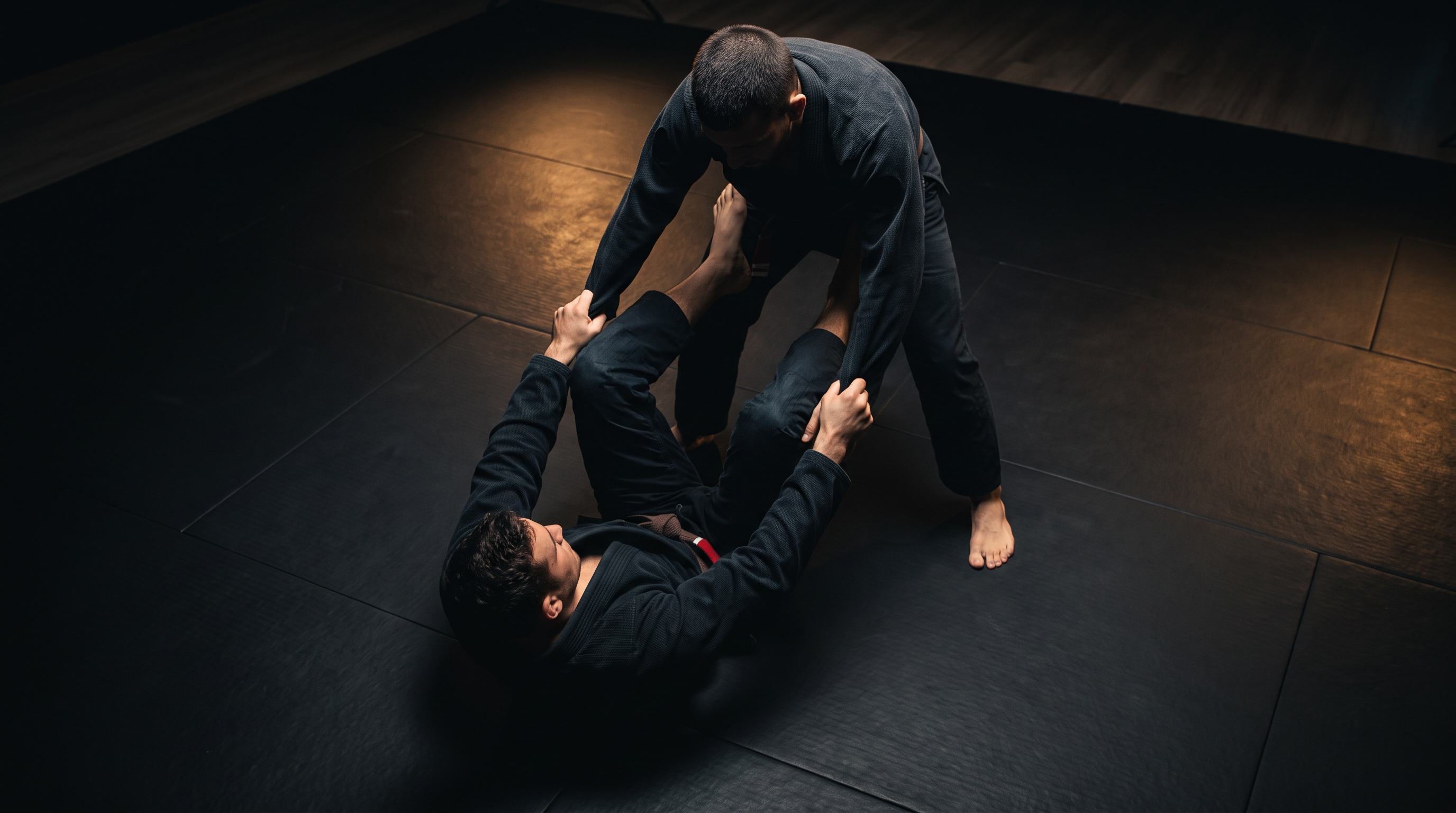
Spider Guard for Beginners: Grips, Sweeps, and How to Keep the Sleeves
TL;DR. Spider guard is an open guard built on two deep sleeve grips and active feet on your partner's biceps. For beginners, the goal is not fancy sweeps — it is keeping the grips, framing with your legs, and off-balancing. Learn the pistol grip on the sleeve, the biceps foot placement, and two sweeps (tripod/knee-push and lasso-style overhead sweep). Drill grip retention first, sweeps second. This guide walks through the position step by step and shows where BJJ Memo helps you actually remember what you drilled.
Spider guard looks flashy on Instagram — legs in the air, sleeves getting yanked, someone flipping over the top. In reality, at white and blue belt, it is one of the most frustrating guards to learn. The grips slip, your legs get tired, and every time you feel a sweep coming, your partner backs out. The good news: spider guard is very learnable if you strip it down to its two real jobs — hold the sleeves and use your legs as levers. Everything else (sweeps, transitions to triangle, lasso, De La Riva combinations) is built on top of that. This guide gives you the smallest useful version: the grips, the frame, and two sweeps you can drill this week. Train it slow, drill it often, and revise it before you roll.
Key takeaways
- Spider guard is an open-guard system where you control both sleeves with a pistol grip and post your feet on your partner's biceps.
- The most important skill for beginners is not sweeping — it is keeping the sleeve grips when your partner tries to strip and pass.
- The pistol grip (thumb wrapping the sleeve cuff with fingers hooked inside) is stronger and safer for your fingers than a bunched fistful of gi.
- Two sweeps are enough for a white or blue belt: the tripod / knee-push sweep and the overhead sweep from a light lasso.
- Keep your hips off the mat and your knees bent — a flat, extended spider guard gets passed almost every time.
- Spider guard is a gi-only position; the sleeve grips are the whole engine, so no-gi training won't build the same skill.
- Drill grip fighting and re-grips more than sweep reps — a spider guard with no grips is just legs in the air.
Why spider guard feels impossible at first
Most beginners try spider guard the way they saw it in an instructional: they grab both sleeves, plant both feet on the biceps, and… lie there flat on their back waiting for something to happen. Their partner pressures forward, drives the knees to one side, strips a grip, and passes.
Here's what is actually going on:
- Your back is flat, so your legs have no leverage. Spider guard is a lever. If your hips are on the mat, your feet cannot push through your partner's frame with any real force.
- Your arms are straight and locked. Straight arms are weak arms. Your partner just needs to circle their elbow inside and the grip is gone.
- You have no plan. You are holding the position and hoping. Spider guard rewards sequences: grip, off-balance, react to the reaction, sweep.
- You are trying sweeps before you can keep the grips. If you cannot keep the sleeves for 20 seconds against pressure, no sweep will ever finish.
Once you fix those four things, spider guard becomes one of the most controlling open guards a beginner can play. It also plugs directly into triangle, omoplata, lasso, and De La Riva — so time invested here pays off across your whole game.
Remember. Spider guard is a grip fight first and a sweep system second. If you can't hold the sleeves, nothing else matters.
A simple system: 6 steps to a working spider guard
Use this as a drilling progression. Do not skip ahead. Each step should feel automatic before you add the next one.
1. Build the pistol grip
Grab your partner's sleeve at the cuff. Instead of bunching the fabric in your fist, slide your four fingers inside the sleeve opening and wrap your thumb over the outside of the cuff. Your hand should look like it is holding a small pistol grip.
This grip is stronger than a bunched grip and, done correctly, is safer for your fingers because the load sits across the whole hand, not on one bent knuckle. Never grip with just the fingertips deep in the sleeve — that is how fingers get jammed.
2. Post the feet on the biceps
From seated or supine, place the ball of each foot on the meat of your partner's biceps, just above the crook of the elbow. Toes point roughly outward. Your knees stay bent — think of your legs as loaded springs, not stilts.
If your feet are on your partner's shoulders or forearms, you are in the wrong place. Biceps or upper arm — that is the anchor point.
3. Get off your back
Prop up on one elbow, or sit up slightly so your shoulders are higher than your hips. This tiny detail changes everything: now your legs can extend and retract with real power, and you can steer your partner side to side instead of just holding them off.
4. Make them move first
Before you attempt anything, use the grips and feet together to push and pull. Extend one leg while pulling the same-side sleeve down; retract the other leg while pulling the other sleeve up. Rock them left and right. You are looking for a reaction — a step forward, a hand posted on the mat, a shoulder dipping.
Sweeps happen in the reaction, not in the setup.
5. Sweep #1 — the tripod / knee-push sweep
When your partner steps a foot forward to base out, this is the classic answer.
- Keep one foot on the biceps.
- Drop the same-side foot off the biceps and hook it behind their far heel (the leg that just stepped up).
- Push their opposite knee away with your other foot.
- Pull both sleeves toward you as you extend the biceps-foot.
They fall backward. You come up on top, still holding a sleeve — start passing.
6. Sweep #2 — the overhead sweep from a light lasso
When your partner drives forward hard, use their momentum.
- Bring one leg through their arm (foot goes over their biceps, shin behind their arm) — a light lasso.
- Keep the other foot on the far biceps.
- Drop your hips slightly, then explode both legs up and over your own head as you pull the sleeves down and past your ears.
They flip over the top. You roll up to mount or come up in a scrambled top position.
Two sweeps. That is enough. Drill them on both sides.
A quick reference table
| Element | What it looks like | Common beginner mistake |
|---|---|---|
| Sleeve grip | Pistol grip: fingers inside cuff, thumb over the top | Bunching fabric in a fist or gripping with fingertips only |
| Foot placement | Ball of foot on the biceps, knees bent | Feet on the shoulders/forearms, or knees locked straight |
| Posture | Shoulders higher than hips, elbow posted | Lying flat on the back with arms extended |
| First action | Push/pull to off-balance | Trying a sweep immediately with no reaction |
| Sweep #1 trigger | Partner steps a foot forward | Forcing the sweep with no step |
| Sweep #2 trigger | Partner drives forward with weight | Trying it against a static, backed-up partner |
Common mistakes and how to fix them
Straight, locked arms. If your elbows are fully extended, your partner will strip your grip in one motion. Keep a slight bend in the elbows and pull the sleeves in toward your chest whenever they try to posture up.
Feet in the wrong place. Feet on the shoulders let your partner smash your knees to one side and start a torreando pass. Feet on the forearms give them zero discomfort. Bicep placement is the standard for a reason — commit to it.
Flat back, no hips. This is the single biggest fix for most beginners. Sit up. Elbow up. Hips slightly off the mat. Watch how much stronger your legs feel immediately.
Chasing the sweep instead of reading the reaction. Spider guard is call-and-response. You off-balance, they react, then you sweep the reaction. If you try to force a sweep against a partner who isn't moving, you will just burn your legs out.
No grip re-establishment plan. Grips get stripped. That is normal, even for black belts. What matters is that you have a habit: sleeve stripped → recover a collar or pants grip → get back to sleeve. Drill grip loss and recovery, not just perfect reps.
Trying spider guard no-gi. Spider guard depends entirely on the sleeve grips. In no-gi it does not exist — you need to play a different open guard (butterfly, single-leg X, De La Riva variants without the gi grips). Do not fight this.
Remember. A tired spider guard is a broken spider guard. If your legs are shaking, retract, get to a stronger position (closed guard, half guard), and rebuild.
Where BJJ Memo fits in
Spider guard has a lot of small details — grip type, foot angle, hip height, which sweep answers which reaction — and those details are exactly what beginners forget between sessions. That is where BJJ Memo helps. Next time you find a good spider-guard breakdown on YouTube (there are excellent free ones from top instructors), paste the link into the app. It turns the video into a structured technique card with steps, key details, and tappable timestamps for the visual moments. Save the card into a "Spider Guard" folder in your personal library, and review it the morning before class. You'll walk onto the mat with the details fresh, drill with intent, and stop re-learning the same position every month. It is a retention tool — it does not replace your coach, it just makes sure the work you already do actually sticks. Learn more at bjjmemo.com or read our guide on how to remember BJJ techniques.
Frequently asked questions
Is spider guard good for beginners?
Yes, if you focus on the fundamentals — grips, posture, and one or two sweeps — rather than trying to copy competition spider guard. It builds strong sleeve control, active legs, and a feel for off-balancing that transfers to almost every other open guard.
Will spider guard hurt my fingers?
Gripping the sleeve incorrectly (fingertips buried deep in the cuff, taking heavy load) is a common cause of finger pain in BJJ. The pistol grip described above spreads the load across the whole hand and thumb, which is much safer. If your fingers hurt, ease off, tape up, and talk to your coach — do not just train through it.
Can I use spider guard in no-gi?
No. Spider guard is defined by the sleeve grips. Without a gi there are no sleeves to grip, so the position doesn't exist in no-gi. If you train no-gi, learn butterfly, single-leg X, or De La Riva-style open guards instead.
How long before spider guard actually works in rolling?
Honestly, it takes patient reps. Most beginners see the grips get stripped for the first few weeks and feel like it's not working. Drill grip retention as a separate skill (positional rounds where your only job is to keep the sleeves) and it will start to click.
What's the difference between spider guard and lasso guard?
Standard spider guard has both feet on the biceps with sleeve grips. Lasso guard threads one leg through your partner's arm (foot over the biceps, shin behind the arm). Many players flow between them — the overhead sweep in this guide uses a light lasso for exactly that reason.
Do I need to be flexible for spider guard?
Not as much as people think. Basic spider guard grips and the two sweeps here don't require unusual flexibility. Advanced entries into triangle and inverted variations do, but you don't need those to play a strong beginner-level spider guard.
Bring it to the mat
Pick one training week and make spider guard your project. Drill the pistol grip until it feels natural. Do grip-retention rounds where your only goal is to keep the sleeves for the round. Add the tripod sweep. Add the overhead sweep. Revise the details before every session so you walk in with a plan.
For real feedback and safety, train the technique at a legit academy with a qualified coach — this article helps you remember and revise, it doesn't replace mat time. When you find a spider-guard instructional you like on YouTube, save it as a technique card in BJJ Memo so it's there before your next roll. Build your own technique library and revise before training — BJJ Memo on iOS and Android.
Last updated 2026-08-28.