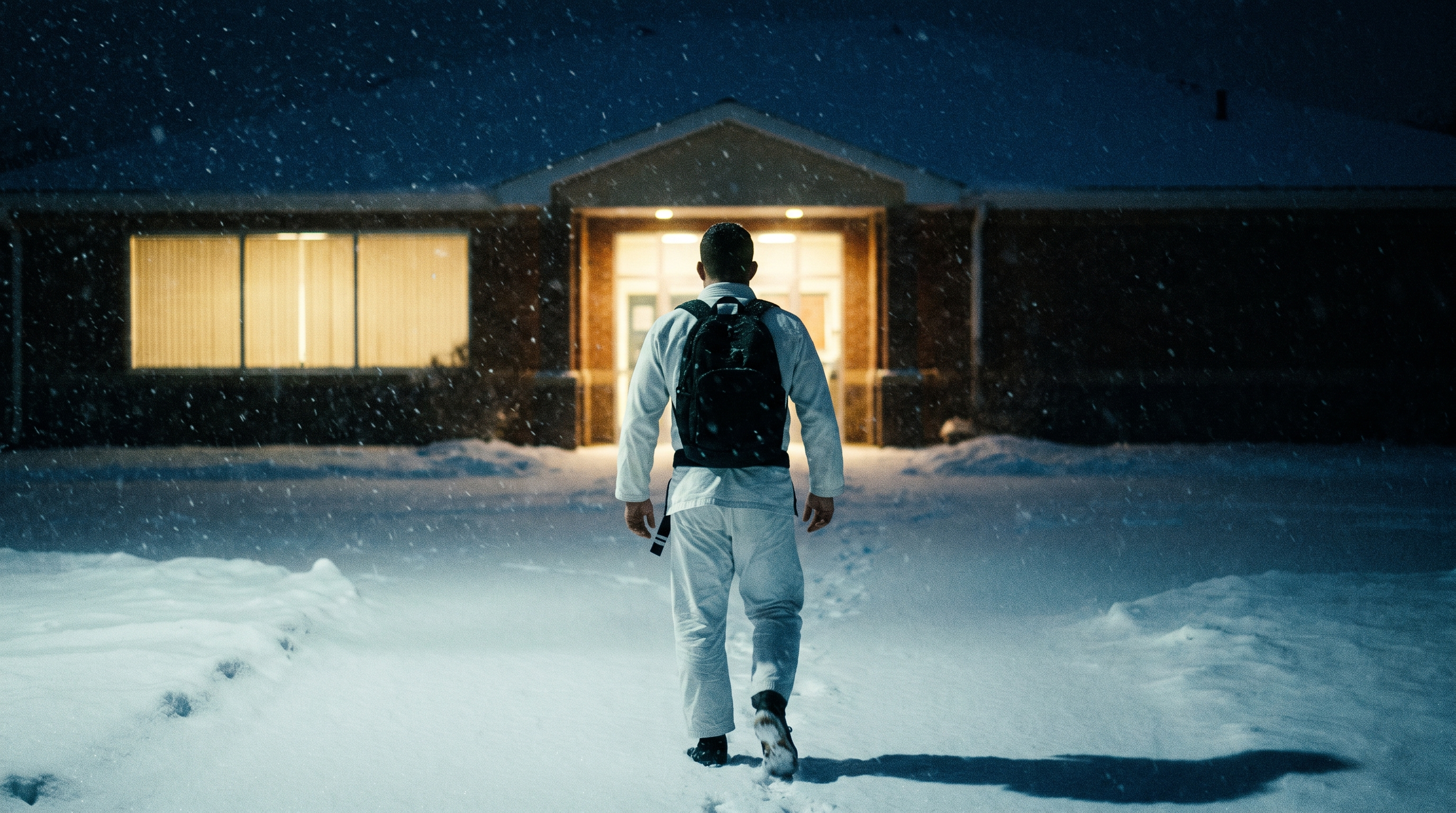
How to Stay Consistent with BJJ Through Winter: A Grappler's Guide to the Dark, Cold Months
TL;DR. Winter is when most hobbyist grapplers quietly fall off — dark commutes, cold gyms, and holiday chaos make it easy to skip a week that turns into a month. The fix is not more willpower; it is a smaller, protected routine, a warm-up you actually finish, and a way to revise techniques on the days you cannot make class. Pick two non-negotiable sessions per week, add short at-home mobility, and use a technique-review habit so your brain keeps learning even when your body is under a blanket.
If you train Brazilian Jiu-Jitsu as a hobby, you already know the pattern. September and October feel great — you are rolling well, the gym is packed, techniques are clicking. Then the clocks change, the sun sets before your evening class, the gi is cold when you pull it on, and one Tuesday you decide to just skip. The next Thursday you skip too. By February, you are the person who "used to train."
This guide is for the grappler who does not want to be that person this year. It is a realistic, coach-friendly approach to BJJ training in winter — not a hardcore challenge, not a motivational lecture. Just a smaller, protected routine and a way to keep learning on the days the mat feels a long way away.
Why winter breaks BJJ habits (and it is not what you think)
Most people blame motivation. Motivation is rarely the real problem. The real problems in winter are logistical and physical:
- The commute changes. Walking or driving to class in the dark, after work, in the cold, feels psychologically much longer than the same trip in July.
- Your body takes longer to warm up. Cold muscles are stiffer, so the first ten minutes of class feel worse, and rolling risks feel higher.
- Illness circulates. One flu cycle through the gym can knock out a week of training for everyone.
- Holidays fragment your schedule. Late November through early January is a minefield of travel, family events, and closed gyms.
- You lose social accountability. Your regular training partners are also skipping, so no one texts "see you tonight?"
Once you see the drop-off as a schedule and environment problem, the solution stops being "try harder" and starts being "design better."
Remember. You do not forget techniques because you are lazy in winter. You forget because you stopped touching them. Any contact — a class, a drill, a five-minute review — keeps the neural pattern alive.
The winter grappling routine: a realistic weekly template
Forget the five-day-a-week fantasy. In deep winter, the goal is protected consistency, not volume. Here is a template most working adults can actually sustain from November through March.
| Day | Session | Duration | Purpose |
|---|---|---|---|
| Monday | Rest + technique review | 10–15 min | Revise cards/notes from last week |
| Tuesday | Class (non-negotiable) | ~90 min | Main technical session |
| Wednesday | Mobility + light drilling at home | 15–20 min | Keep hips, shoulders, neck warm |
| Thursday | Class (non-negotiable) | ~90 min | Positional sparring / rolling |
| Friday | Rest | — | Recovery |
| Saturday | Optional open mat OR full rest | 60–90 min | Bonus mat time if you have it |
| Sunday | Weekly review + planning | 10 min | Pick focus for next week |
Two classes plus two short at-home sessions is enough to keep your game moving forward. The moment you protect those two class slots the way you protect a work meeting, winter stops eating your progress. For the underlying philosophy of small consistent reps, see our guide on building a sustainable BJJ training habit.
The pre-class ritual that saves your season
A cold body is an injured body waiting to happen. In winter, extend your personal warm-up so you arrive at the gym already loose:
- At home, 10 minutes before leaving: 20 hip circles per side, 10 shoulder rolls, 10 neck circles, 30 seconds of standing thoracic rotations.
- On the drive/walk: stay layered and warm — a hoodie under your coat matters.
- At the gym, 10 minutes before class: light movement flow, a few shrimps, a few technical stand-ups, easy breakfalls. Get your heart rate up before the coach starts.
Skipping this in July is fine. Skipping it in January is how people tweak their back on the first takedown drill.
How to stay motivated for BJJ in winter without relying on motivation
Motivation is a mood. Systems beat moods. Here is what actually works when the weather is against you.
1. Shrink the commitment, then keep it
Tell yourself: "I only have to show up and warm up." If after the warm-up you still want to leave, you can. You almost never will. This works because the friction is in starting, not in doing.
2. Use a training-partner text chain
One short group chat with two or three training partners: "Tuesday, 7pm, see you there." Public micro-commitments are stickier than private promises. When someone else expects you on the mat, you go.
3. Pick a winter focus
A vague "train more" goal is easy to abandon. A specific one — "this winter I am rebuilding my closed guard" — gives every session a purpose. Pick one position or submission chain and study it deliberately from November to March.
4. Turn off-days into learning days
This is the part most hobbyists miss. Even if you only make it to two classes a week, you can still be learning on the other five days by reviewing what you already saw. Watch a short instructional clip. Re-read your notes. Mentally rehearse a sweep from your guard. This is where a technique-retention system earns its keep — you can revise your saved cards in ten minutes on the couch instead of losing them entirely.
Remember. Winter is not lost time if you keep learning. A grappler who trains twice a week and revises daily will be sharper in March than one who trains four times a week and never reviews.
How to avoid the BJJ winter slump
The slump has a specific pattern: you miss one week, feel rusty, feel embarrassed, avoid the gym to skip the embarrassment, and the cycle deepens. Here is how to interrupt it.
- Return within seven days of any missed week. The longer the gap, the harder the return. A single skipped week is a break. Two becomes a habit.
- On your return session, pick lower-intensity rounds. Roll with people you trust. Do not try to prove anything. Your goal is only to reset the habit.
- Do not compare winter you to summer you. Different season, different conditions, different expectations. Compare winter you to the version of you that quit.
- Log every session. A simple checklist on your phone works. Seeing four checkmarks for the month, even a rough month, keeps the identity alive: "I am someone who trains."
- Get your gi dry. A wet, cold gi on Thursday morning is a real reason people skip Thursday night. Rotate two gis in winter if you can.
If you get sick
BJJ has an honest rule: if it is above the neck, you can usually train light. If it is below the neck, or contagious, you stay home. Do not be the person who brings the flu into the gym in January — you will take out half your training partners and set the whole room back a week.
While you recover, this is prime technique-review time. You cannot drill, but you can absolutely watch, read, and rehearse. See our take on how to learn BJJ from YouTube instructionals for a structured approach.
Traveling for the holidays: keep the habit alive
The holidays are where good winter routines go to die. A few things that work:
- Find one open mat wherever you are going. Most cities have a gym that welcomes visitors for a drop-in fee. One session on the road is worth ten skipped sessions at home.
- Pack a rash guard and shorts. No gi is easier to travel with and easier to say yes to.
- If no gym is available, do 15 minutes of solo drilling. Shrimps, technical stand-ups, granby rolls, hip escapes. In a hotel room. In your parents' living room. It counts.
- Review, review, review. Long flights and quiet evenings at family gatherings are perfect for going through your technique library.
A week off the mat does not undo your game. A week off the mat plus two weeks of avoidance when you get home does.
How to maintain what you built when spring comes
The grapplers who make it through winter tend to explode in spring — sharper, calmer, and ahead of the people who took three months off. To lock that gain in:
- Do not spike your volume in March. Ramp back up gradually. Add one session, train it for two weeks, then add another. Sudden volume jumps cause injuries.
- Keep the review habit. The daily technique-review discipline you built in winter is more valuable than the extra classes. Do not drop it just because summer is easier.
- Audit your winter focus. If you spent November to March on closed guard, actively test it in open rolls now. Did it work? What is missing? Pick your next winter project early — future you will thank present you.
- Write down what worked. Which two class slots were sacred? Which warm-up got you loose? Which partner kept you accountable? Save the formula for next winter.
A quick word on safety
Cold-weather BJJ has slightly higher injury risk in the first minutes of any session. Take the warm-up seriously, communicate with partners on tap timing, and do not force a stiff joint into an unfamiliar position just to "prove" you are back. If something feels wrong, sit the round out. There will be a Tuesday next week.
For real feedback and safety, train the technique at a legit academy with a qualified coach — a retention app helps you remember and revise, it does not replace mat time.
Frequently asked questions
How many times a week should I train BJJ in winter?
For most working adults, two protected sessions per week is enough to maintain skill and keep the habit alive. Three is great if your schedule allows. The critical thing is that those sessions are non-negotiable — treat them like a work meeting you cannot move.
Is it bad to train BJJ when it is cold?
No, but a cold body needs a longer warm-up. Arrive already warm, extend your personal warm-up by five to ten minutes in winter, and be more cautious in the first few rolls. Most winter injuries happen in the first fifteen minutes of a session because people jump into hard drilling with stiff joints.
How do I stay motivated for BJJ when it is dark and cold?
Stop relying on motivation and design better systems. Protect two fixed training slots, set up a partner text chain for accountability, shrink the commitment to "show up and warm up," and pick a specific winter focus (one position or submission chain) so every session has a purpose.
Will I lose all my BJJ progress if I skip a few weeks?
A few weeks off will make you feel rusty, but the skill is not gone — the neural patterns fade slowly, not instantly. The bigger risk is the psychological one: the longer you stay away, the harder returning feels. Get back within seven days of any missed week and pick light rounds on your return session.
What should I do on rest days in winter?
Spend ten to fifteen minutes reviewing techniques you have already learned — old notes, saved instructionals, or technique cards. Mentally rehearse a specific sweep or escape. Off-day review is how you keep progressing even when you are training less often.
How do I avoid the BJJ winter slump?
Catch it early. The slump follows a predictable pattern: miss one week, feel rusty, avoid the gym to skip the rustiness, and the cycle deepens. Interrupt it by returning within seven days of any gap, choosing lower-intensity rounds for your first session back, and comparing winter-you to the version of you that quit — not to summer-you.
Turn winter into your best learning season
Winter is not the enemy of your jiu-jitsu. It is a filter. The grapplers who make small, boring, consistent decisions from November to March walk onto the mat in April with a sharper game and a deeper library of techniques than the ones who trained hard in the summer and disappeared in the winter.
Next time you watch an instructional or leave class with something worth remembering, save it as a technique card in BJJ Memo so it is there on the couch, on the plane, and on the Tuesday morning when you need a reason to show up that night. Build your own library, revise before training, and let winter become the season you quietly got better while everyone else took a break.
Available on iOS and Android. Explore more retention-focused guides on the BJJ Memo blog.
Last updated 2026-09-20.