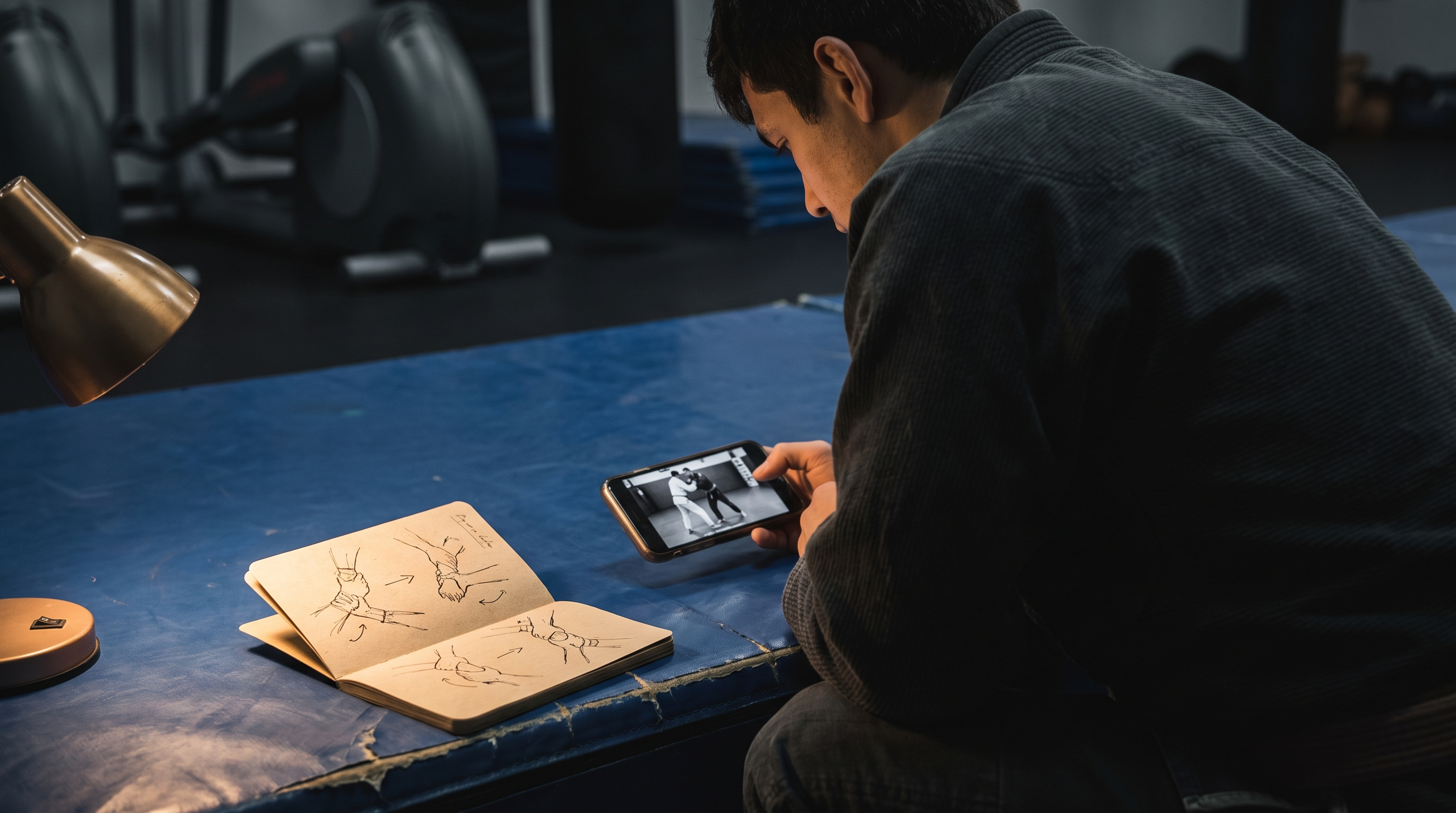
How to Turn a 10-Minute BJJ YouTube Video Into a Technique You'll Actually Land in Rolling
TL;DR. Most grapplers watch BJJ YouTube videos passively, understand the move for a few minutes, then forget it before their next class. To convert a 10-minute instructional into a technique you can hit in rolling, you need a repeatable loop: watch with intent, extract the key details, drill it isolated, then feed it into positional sparring. Written notes or a structured technique card make the difference between a move you 'know' and a move you can execute under pressure.
You finish a Gordon Ryan breakdown, a Lachlan Giles guard-passing series, or a random black belt's kimura setup on YouTube. It clicks. You picture yourself using it that week. Then Tuesday's class rolls around, you're in bottom half-guard against a training partner, and… nothing. The move is gone. You can barely remember the grip, let alone the sequence.
This isn't a memory problem. It's a process problem. Watching a technique is not learning it — it's the first 10% of learning it. Below is a repeatable system that self-studiers use to close the gap between watching a video and actually landing the move on a resisting partner. It works whether you're a white belt studying the fundamentals or a purple belt building a specific game.
Key takeaways
- Passive video watching feels productive but rarely transfers to live rolling without deliberate breakdown.
- Every technique has three layers: the frame (position/grips), the mechanic (the movement), and the reaction (what the opponent does).
- You need to isolate 2-4 key details per video — trying to remember everything guarantees you remember nothing.
- Drilling without resistance builds the pattern; positional sparring from the exact starting frame builds the reflex.
- Reviewing your notes the day before training is when retention actually happens, not while you're watching.
- Write down the failure mode: the counter or common mistake that will stop the move working on a live partner.
- One video studied properly beats ten videos watched casually — depth of processing beats volume of consumption.
Why this happens: the passive-consumption trap
BJJ instructionals on YouTube are designed to feel clear. The instructor demonstrates in ideal conditions, on a partner who feeds the exact reaction, with the camera angle chosen to make the mechanic obvious. Your brain confuses understanding the move with owning the move. They're not the same thing.
There's also a volume problem. The average self-studier scrolls through several videos in one sitting — an armbar setup here, a knee cut there, a leg lock entry after that. None of it sticks because none of it gets processed deeply. It's the BJJ equivalent of skim-reading five books at once.
The other issue is context. In a video, you watch the technique from one starting position, with one reaction. On the mat, your training partner isn't reading from the same script. Their grip is slightly different, their base is heavier, they're already framing on your hip. If you only encoded the ideal version, you have nothing to fall back on when reality doesn't match.
Remember. You don't forget techniques because you're bad — you forget because you never revised them, and never drilled them against the specific counter that shows up in live rolling.
A simple system: 6 steps to actually land what you watched
Here's the loop. It takes about 25-30 minutes per video the first time, and much less once you've internalised it. Don't skip steps — the steps are what separates "I watched a video" from "I can hit this move."
1. First pass — watch the whole video at normal speed
Don't take notes yet. Just watch. Your job here is to understand the overall shape of the technique: where it starts, what the finish looks like, and roughly how you get from A to B. If you pause and scrub every three seconds on the first pass, you'll get lost in details before you've seen the map.
Ask yourself one question at the end: What position is this actually for? If you can't state the starting position and the ending position in one sentence, watch it again.
2. Second pass — extract the three layers
Now rewatch, pausing as needed, and identify:
- The frame: where are the hips, hands, feet, and grips at the starting position? Down to the specific grip (four-finger, C-grip, cross-collar, wrist-to-wrist).
- The mechanic: what is the one movement that makes the technique work? Every technique has a hinge — a hip escape, a shoulder drop, a step-over. Find it.
- The reaction: what is the opponent doing that makes this the right move? If they weren't reacting that way, would the move still make sense?
Most videos bury these under decoration. Your job is to strip the technique down to these three layers.
3. Isolate 2-4 key details, not everything
Here's where most self-studiers fail: they try to remember every detail the instructor mentioned. "Toes pointed, hip out at 45°, elbow tight, chin down, cross-face pressure, foot on the shelf, grip cupping the tricep…" Your brain will keep three, maybe four.
Pick the details that, if you got them wrong, the move would fail. Everything else is optimisation. Write those 2-4 details down. This is the single highest-value step in the entire process.
4. Write it up in a structured note
A scribbled note in your phone's notes app is better than nothing, but a structured breakdown is dramatically better. Use a template like this:
| Field | What to write |
|---|---|
| Position / start | e.g. "Bottom closed guard, cross-collar grip established." |
| Trigger | What the opponent does that opens the move. |
| Key details (2-4) | The details you decided actually matter. |
| Common mistake | What the instructor said goes wrong most often. |
| Counter to know | The obvious defence and how you'd respond. |
| Drill goal | "Land it three times in positional sparring from this exact grip." |
This is where a BJJ video breakdown stops being a mental thing and becomes something you can actually revise before class. If you're interested in a tool that structures this automatically from a YouTube link, see our note on organising your technique library.
5. Drill it slowly, without resistance, on a compliant partner
Before you try to use the move live, you need to run it. Ask a training partner for five minutes before or after class. Start in the exact frame from the video. Move slowly. Focus on executing your 2-4 key details, not on speed.
Goal: get 10-20 clean, slow reps where the mechanic feels smooth. Don't add resistance yet. This is pattern-building.
6. Feed it into positional sparring — from the exact starting frame
This is the step almost everyone skips, and it's the reason techniques from YouTube don't show up in rolling.
A free roll starts from standing or open guard — the odds you'll end up in the exact position your video started from are low. So you'll never get to try the move. That's why you need positional sparring: agree with your partner to start from the specific frame (bottom half-guard with an underhook, side control with a cross-face, whatever), reset every 60 seconds, and only work that scenario.
Do three or four rounds like this over one or two sessions and the move goes from "video knowledge" to "reflex you can find under pressure."
Remember. Positional sparring from the starting frame of the video is the missing link between studying and executing. Free rolling alone will not close that gap.
Common mistakes when learning BJJ from YouTube
Even with a good system, there are traps.
Watching too many videos before drilling any. You collect 20 saved instructionals and drill zero of them. Rule: never save a second technique on the same position until you've drilled the first one on the mat.
Copying the finish, ignoring the setup. People love watching submissions. But most submissions fail because the setup is wrong, not the finish. Study the grip, the trigger, and the opponent's reaction — the finish takes care of itself.
Trusting flashy over fundamental. A worm-guard-to-berimbolo-to-heel-hook video is exciting to watch and useless at white belt. Pick videos that match your level and your problems. If you get smashed in side control, watch side control escapes — for a full week.
Not writing down the counter. Every technique has a counter. If you don't know the counter, you don't know the technique. Ask yourself: If my partner did the obvious thing to stop this, what would it be, and what's my answer?
Skipping the revision. You wrote clean notes and never opened them again. Notes you don't revise are notes you don't remember. Revisit them the night before or the morning of the training session where you plan to use the move.
Trying to install five new techniques at once. Pick one. Drill it for two weeks. Then pick the next. Grapplers who add one technique to their game per month are moving fast — most add fewer.
Where BJJ Memo fits in
The hardest step in the loop above is step 4 — writing a structured breakdown you'll actually revise. Most people do it once, in a note that gets buried, and never open it again.
BJJ Memo is built to remove that friction. You paste a YouTube URL into the app, and it generates a structured Technique Card with the steps, the key details, and tappable timestamps for the moments that matter — filed automatically into a searchable library organised by position. The revision flow surfaces those cards before your next session so the details are fresh when you step on the mat.
It doesn't replace drilling or coaching. It replaces the messy notes you never re-read. If you want to see how the library is structured, check the BJJ Memo blog for more on retention-focused study habits.
Frequently asked questions
How many BJJ YouTube videos should I study per week?
Fewer than you think. One or two videos studied deeply — meaning full breakdown, drilling, and positional sparring — will move your game further than ten videos watched casually. Depth of processing beats volume every time. If you're currently saving five videos a week and drilling none, cut the intake.
Can I actually learn BJJ from YouTube without a coach?
Not entirely. YouTube is excellent for details, concepts, and expanding what you've already been taught. It's a poor substitute for a coach because it can't correct your posture, timing, pressure, or grip strength in real time. Use video study as an amplifier for your mat time, not as a replacement for it.
What's the best way to remember BJJ techniques from videos long-term?
Write a structured note with 2-4 key details, drill the move within a week of watching it, and re-read the note the day before you plan to use it. The combination of active encoding (writing), motor rehearsal (drilling), and spaced review (re-reading) is what makes retention stick. Passive re-watching alone is one of the least effective methods.
Should I take notes during the video or after?
After. Note-taking during the first watch splits your attention and you miss the shape of the technique. Watch the full video first, then rewatch with the intent to extract the frame, the mechanic, the reaction, and the 2-4 key details. Writing after forces you to summarise, which is where actual learning happens.
How do I apply BJJ video techniques when my training partner reacts differently?
Expect it. The version in the video is the ideal version — real partners will grip differently, be heavier, or already be defending. This is why positional sparring from the same starting frame matters: you get repeated attempts against a live, unpredictable reaction, so the technique gets attached to the problem it solves, not just the ideal setup.
Which BJJ YouTube channels are worth studying?
Any channel run by an active black belt or credentialed competitor is a reasonable starting point. Look for instructors who explain why a detail matters, not just what to do. Match the channel to your level: if you're a white belt, prioritise fundamentals-focused channels over highlight-heavy or advanced no-gi leg-lock content until your base is solid.
Final word — and a note on your coach
A YouTube library is a superpower for a self-studier, but it's an amplifier, not a foundation. The foundation is a legit academy, a qualified coach, and hours on the mat with resisting partners. Everything above helps you get more out of that mat time — it doesn't shortcut around it.
If you're ready to stop losing techniques between your phone and your next class, try BJJ Memo on iOS or Android. Paste a video, get a structured card, revise it before training. Turn what you watch into something you can actually use.
Last updated 2026-09-21.