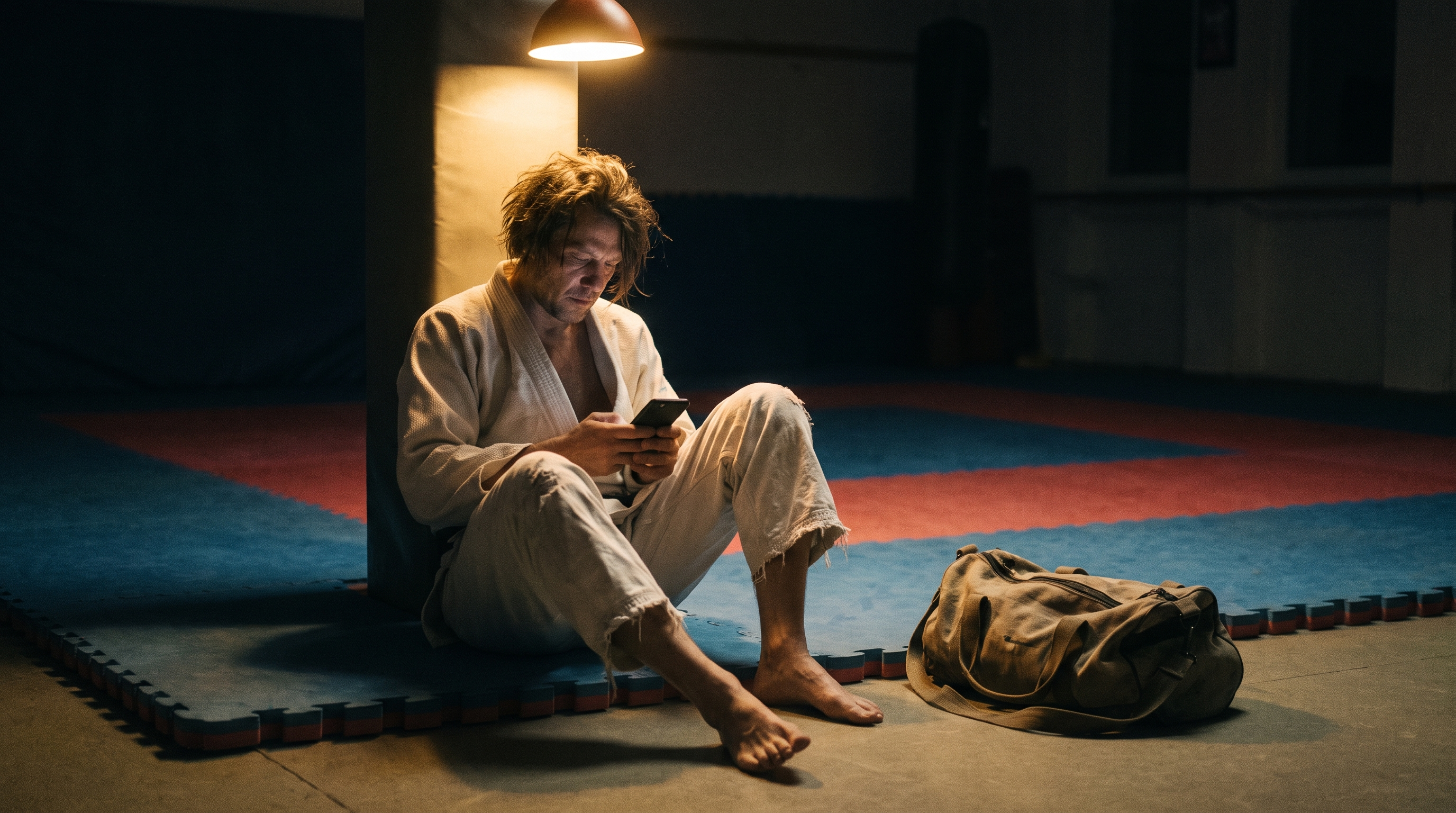
The Working Parent's Guide to BJJ: How to Keep Progressing on 2 Sessions a Week
TL;DR. Working parents can absolutely keep progressing in BJJ on two mat sessions a week, but only if the time between classes stops being wasted. The winning formula is small: one focused goal per class, a short written or visual note straight after training, and 5–15 minutes of quiet review on non-mat days. Stop trying to learn everything, protect a narrow game, and treat retention — not volume — as the real bottleneck.
You finish work late. Bath, dinner, bedtime story. By the time the house is quiet you're too tired to think about triangles, let alone drill them. Then the guilt kicks in: the twenty-year-old blue belts at your academy train five times a week. You get two, if the calendar cooperates. Are you actually going anywhere?
Yes — but not by copying their template. This guide is built for the grappler who has a job, a partner, kids, and roughly two mat sessions to work with per week. It is about protecting a small, sharp game, cutting technique overload, and using short pockets of time between classes so you actually remember what your coach showed you.
The specific constraint: two sessions, one tired brain
Most BJJ advice is written for people whose main constraint is willingness. Yours is different. You have willingness. You have shortage of hours, shortage of sleep, and shortage of uninterrupted attention.
That changes the strategy. A hobbyist training three or four times a week can afford to sample techniques, follow every new curriculum the coach rolls out, and let repetition slowly stitch things together. On two sessions a week that approach quietly fails. By the time you get back to the mat, most of last class's detail has faded. You re-learn instead of building.
The working parent's real enemies:
- Forgetting. Techniques are perishable. Without deliberate review, much of the fine detail is gone by your next class.
- Technique overload. Coaches show a lot in an hour. Trying to hold onto all of it means holding onto none of it.
- Fragmented energy. Rolling hard when you're sleep-deprived leads to sloppy habits and injury risk.
- Guilt spirals. Comparing your schedule to full-time hobbyists makes you either overtrain (and get hurt) or quit.
Remember. You are not behind. You are running a different race. Judge your progress by how well you remember and apply your own game, not by mat hours logged.
Once you accept the constraint, the plan gets simpler: narrow the game, protect retention, and use the tiny windows life gives you. For a deeper look at building a focused game from a small technique pool, see our guide on how to build a personal BJJ game.
Daily 5–15 minute structure between classes
You do not need a garage full of mats or a training partner at home. You need a phone, a floor, and a plan. The goal of these micro-sessions is not to "train BJJ" — it is to keep the neural pathway warm on what you already learned in class.
Here is a structure that fits into the gaps of a working parent's day: after the kids are down, on a lunch break, or before the morning coffee.
The 5-minute version (any day, any excuse)
- Minute 1: Open your notes or technique card from your last class. Read the steps aloud.
- Minutes 2–4: Mentally rehearse. Close your eyes and walk through the technique frame by frame — grips, weight, hip angle, finish.
- Minute 5: Note one question or gap for your next class ("what if they post the far arm?").
Mental rehearsal is not a gimmick. It is a low-cost way to lock in the sequence of a movement without needing a partner or space.
The 10-minute version (a few evenings a week)
Add solo movement to the review above:
- Hip escapes (shrimping), both sides.
- Technical stand-up reps.
- Guard retention pummelling on your back — inverting slowly, recovering knee-shield, framing.
- Bridge and roll (upa) reps.
Slow, deliberate reps. This is not conditioning. It's grooving the shapes.
The 15-minute version (once or twice a week)
Add a short, focused film study:
- Pick ONE clip — an instructional segment, a match breakdown, a coach's video — that relates directly to your current focus position.
- Watch it once without pausing. Watch it again and write down (or save) the two or three details that matter.
- Do NOT open a second video afterwards. The temptation to keep watching is where retention dies.
Remember. A single clip watched with full attention and captured in notes will teach you more than an hour of passive scrolling through highlights.
The common failure pattern (and the fix)
Almost every working-parent grappler I've spoken to hits the same wall. It looks like this:
- You attend class. Coach shows a great technique.
- You drill it a few times. It feels okay.
- Life happens. Work deadline, sick kid, birthday party.
- Four or five days later you return to class. Coach shows something new.
- You realise you cannot remember the technique from last week clearly enough to try it in rolling.
- Repeat.
After a few months, you notice that your rolling game hasn't really changed. You defend well, you survive, but you're not adding weapons. Meanwhile the blue belts around you are stacking new tools every month. The gap widens.
The fix has three parts, and the order matters.
1. Capture the same day. The single highest-leverage habit for part-time grapplers is writing down (or otherwise capturing) what you learned within a few hours of class. Not the next day. That day. Steps, grips, key details, common mistakes your coach called out.
2. Choose a focus, not a menu. Pick ONE position to be your project for the next several weeks — closed guard, side control escapes, half guard bottom, whatever fits your body and preference. When coach shows something else, learn it, note it, but don't force yourself to integrate it. Your rolling energy goes into your focus position.
3. Review before the next class. In the hour or so before you leave for the gym — while you're getting your gi bag ready — re-read your notes from last class. Especially the ones tied to your focus position. This is the difference between arriving cold and arriving primed.
A simple table to see the difference in a training block:
| Habit | Two sessions a week, no review | Two sessions a week, with review |
|---|---|---|
| Techniques encountered per month | Many | Many |
| Techniques actually retained | Few, fuzzy | Fewer, but sharp |
| Rolling improvement | Random | Directional |
| Frustration level | High | Manageable |
| Time cost outside the gym | Zero | Roughly 30–60 min per week |
The cost is small. The compounding is significant.
The BJJ Memo feature that helps most: the Technique Card
This is the one place a tool genuinely earns its space in your life as a working parent: capture and review.
BJJ Memo's Technique Card feature is designed for exactly this workflow. You paste a BJJ YouTube URL — a clip your coach recommended, an instructional segment, a match breakdown you filmed at a seminar — and the app produces a structured card: the steps, the key details, and tappable timestamps for the visual moments that matter.
Why this specifically matters for you:
- It removes the friction of note-taking. After a long workday, opening a blank notes app to write out a technique feels impossible. Pasting a link and getting a structured card is a task you can do in the two minutes before your kid asks for another glass of water.
- It stores everything in a searchable library. You accumulate a personal, position-tagged library of the techniques you actually care about, not a chaotic camera roll of half-watched clips.
- The review flow supports the pre-class habit. On the way to the gym, you can pull up your cards for your focus position and re-read the details in five minutes.
One tool, one job, done well. That's what a working parent needs — not another app that demands daily engagement, not another feed to scroll. Save what matters, revise before you train, close the app.
For more on how to structure technique notes so they're useful weeks later, browse our articles on BJJ retention and note-taking.
A sample 7-day plan for a two-session-per-week parent
Assume Tuesday and Saturday are your two mat days — the classic working-parent split (a weeknight after bedtime, and one weekend session). Adjust the days to whatever your reality allows.
| Day | Time on task | What you do |
|---|---|---|
| Monday | 5–10 min | Review last Saturday's technique card. Mental rehearsal of your focus position (e.g. closed guard). One clarifying question written down for coach. |
| Tuesday | Class (60–90 min) + 10 min after | Attend class. In the car / on the train / before bed, capture the technique into a card. Note grips, angle, one mistake to avoid. |
| Wednesday | 10 min | Solo movement: hip escapes, technical stand-ups, bridge and roll. Slow, focused reps. No music, no phone. |
| Thursday | 15 min | Focused video study: ONE clip on your focus position. Save it as a technique card. Extract two details. |
| Friday | 5 min | Read through your two most recent cards. Rest the body — sleep matters more than another drill. |
| Saturday | Class (60–90 min) + 10 min after | Attend class. Prioritise rolling with intent — try to hit ONE thing from your focus position, even if it fails. Capture the new class technique the same day. |
| Sunday | 0–10 min | Optional rest day, or a short mobility routine. If you have energy, quickly re-tag or organise your library so it's easy to find things next week. |
Total off-mat time: roughly 45–60 minutes across the week, split into tiny pockets. No single block is long enough to disrupt family life.
Remember. The plan above is deliberately easy. If a week goes sideways — sick kid, deadline, travel — you fall back to just the 5-minute mental rehearsal on class days. Missing everything else does not undo your progress. Missing the review does.
Training BJJ with kids: practical honesty
A few blunt truths for the parent side of this equation:
- Your body is not your body from before kids. Sleep is broken, you sit at a desk more, and you carry small humans at weird angles. Warm up longer. Tap earlier. Pick training partners who roll with control.
- Injury is more expensive now. A tweaked knee for a single 25-year-old is annoying. For a parent with a full-time job and school runs, it's a small crisis. Train accordingly.
- Your kids are watching. Showing up consistently to something hard — even just twice a week — teaches them something you cannot teach with words.
- Communicate the schedule. "Tuesday night and Saturday morning are Dad's / Mom's BJJ" as a fixed family agreement is worth more than trying to sneak sessions in.
For more on training smart as an adult hobbyist, see our writing on avoiding burnout and training consistently.
Frequently asked questions
Is two BJJ classes a week really enough to get better?
Yes, if you're honest about the trade-off. You will not progress as fast as someone training four or five times a week, and you shouldn't expect to. But steady, retained progress is very achievable on two classes a week when you narrow your focus and review consistently between sessions. Many blue and purple belts got there on part-time schedules.
What's the single most important habit for a part-time BJJ hobbyist?
Capturing what you learn the same day you learn it. The details of a technique fade quickly without reinforcement. A short, structured note — steps, grips, key detail, common mistake — taken the evening of class is the difference between remembering it next week and having to re-learn it from scratch.
How do I choose a focus position when I don't know what my "game" is yet?
Pick something you already tend to end up in during rolling, or a position your body type suits (long-limbed players often gravitate to guard; stockier, stronger builds often to top pressure). Commit to it for a training block — several weeks at minimum — before deciding whether to keep it. The point is to stop being a tourist in every position.
Should I train more when work gets quiet, or keep the same schedule?
Consistency beats spikes. Two sessions a week, every week, will outperform three sessions one week and zero the next. Your body adapts to the load you give it regularly. If you genuinely have more time, add a short open mat or solo drill session — not a third hard class that leaves you wrecked for the family.
How do I stop feeling behind compared to full-time hobbyists at my gym?
Stop measuring yourself against their volume and start measuring yourself against your own game a month ago. Can you hit the sweep you're working on more reliably? Do you remember more of what your coach showed? Are you tapping less to the same techniques? Those are your metrics. Mat hours are theirs.
Is watching BJJ YouTube instructionals a waste of time?
Only if you watch passively. One clip, watched with attention, tied to a position you actually train, captured in notes, and reviewed before your next class is genuinely useful. Ten clips scrolled through on the couch is entertainment, not training. Quality of engagement matters more than quantity of videos.
Turn what you watch into something you'll actually remember
You already have the hardest thing: the willingness to keep showing up. What you need now is a system that respects your time.
Next time your coach mentions a great YouTube clip, or you find an instructional segment worth studying, save it as a technique card in BJJ Memo. Build your personal library one position at a time, and revise the relevant cards on the way to class. Two mat sessions a week, plus five to fifteen focused minutes a day, is a serious training week for a working parent — as long as nothing you learn slips through the cracks.
For real feedback and safety, train the technique at a legit academy with a qualified coach — BJJ Memo helps you remember and revise, it doesn't replace mat time.
Build your own technique library and revise before training — BJJ Memo on iOS and Android.
Last updated 2026-09-19.