The Working Parent Grappler: How to Keep Improving at BJJ on Two Classes a Week
TL;DR. Working-parent grapplers don't lose progress because they're bad — they lose it because two classes a week isn't enough contact to lock techniques in. The fix isn't more mat time you don't have; it's short, structured retention work between sessions (5–15 minutes), a narrow focus (one or two positions per month), and a system to capture what you learn before you forget it. This guide gives you a daily micro-routine, a 7-day plan, and the common failure pattern that quietly stalls busy grapplers.
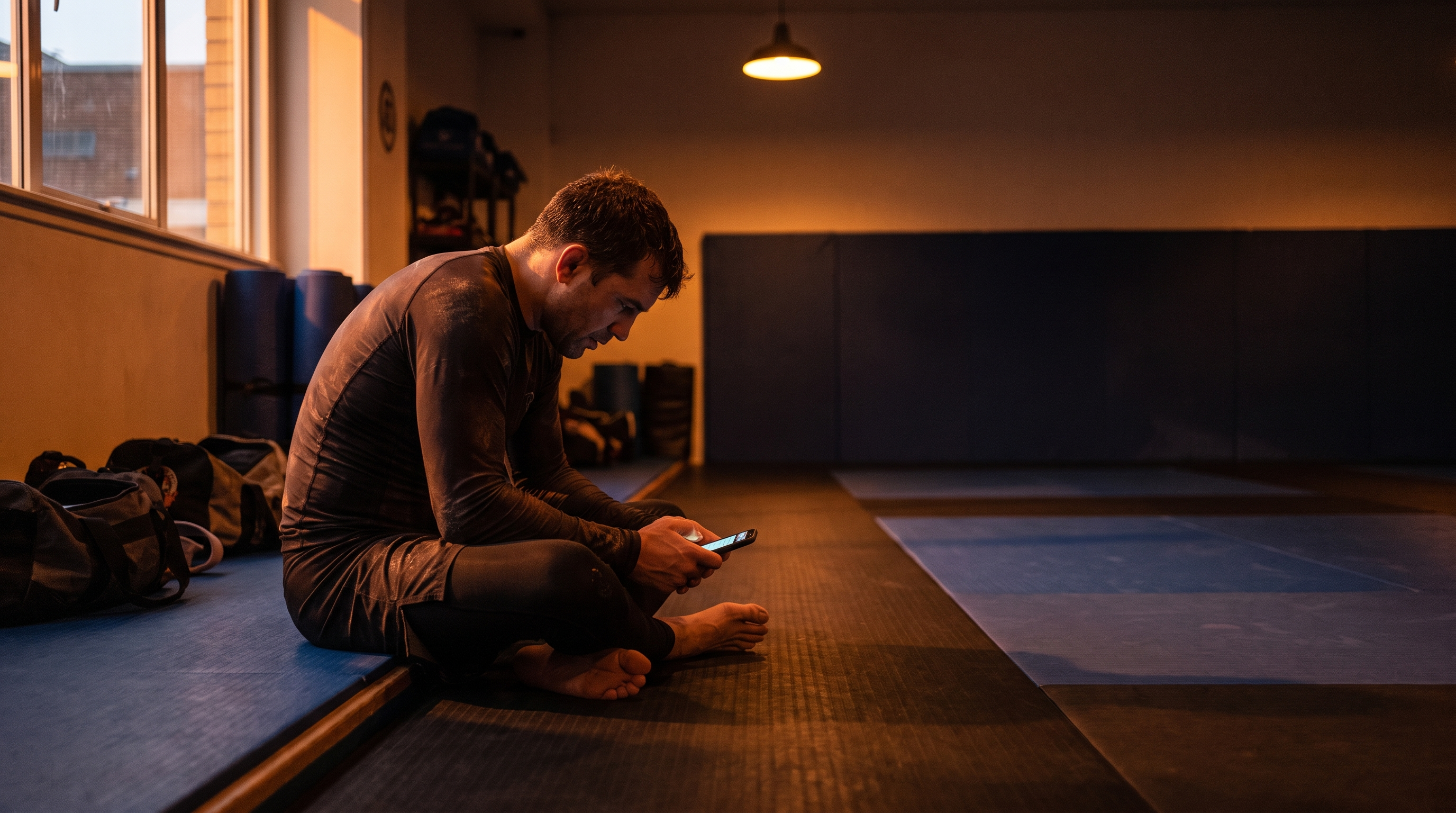
If you're reading this at 10:47 pm with kids finally asleep, a work laptop still open, and a nagging feeling that you're falling behind the guys who train five times a week — you're the audience for this article. You don't need someone telling you to "just train more." You need a way to make what you already do stick.
Key takeaways
- Two classes a week can produce steady BJJ progress if you protect the time between classes with short, deliberate retention work.
- The biggest killer of progress for working-parent grapplers isn't intensity — it's context loss between sessions.
- A 5–15 minute daily micro-routine (review notes, visualize, isolate one detail) compounds faster than occasional long open-mat sessions.
- Narrow your focus: pick one position per month (e.g. escaping side control) and let everything else be maintenance.
- Capture technique details the same day you learn them — memory fades quickly when your next class is 3–4 days away.
- Structured revision beats re-watching random YouTube videos; you need to revisit specific details, not consume new ones.
- Coaching and live rolling stay non-negotiable — retention tools help you make more of the mat time you already have, not replace it.
The specific constraint you're training against
A hobbyist without kids can train four times a week, roll hard, watch instructionals on the couch and think about jiu-jitsu at leisure. Their sessions are close enough together that Tuesday's guard pass detail is still fresh on Thursday.
As a working parent, your reality is different:
- Your two sessions are usually 3–4 days apart, sometimes with a weekend break in between.
- Between sessions, your brain is loaded with work meetings, school pickups, meal prep, laundry, and everything else that isn't grappling.
- "Study time" is measured in five-minute pockets — the drive home, the moment before bed, standing in line at the grocery store.
- Family time is non-negotiable, and it should be.
This is not a motivation problem. It's a memory and continuity problem. By the time Thursday's class rolls around, most of Tuesday's technical detail is gone. You re-learn the same shoulder pressure, the same underhook timing, the same grip sequence — over and over — instead of building on it.
You don't forget techniques because you're bad. You forget because you never revise them.
Remember. With limited mat time, your leverage is not in the class itself — it's in the 72 hours between classes.
The 5–15 minute daily structure
The goal is not more training. The goal is to keep the previous class "loaded" in your head until the next one, so each session builds on the last. Here's a realistic micro-routine that fits into a working parent's day.
The three retention modes
| Mode | Time | When | What you actually do |
|---|---|---|---|
| Capture | 5 min | Same day as class | Write down 1–3 key details before you forget them |
| Review | 5 min | Non-class days | Re-read your notes; visualize the movement |
| Deep-dive | 10–15 min | Once or twice a week | Re-watch one instructional clip on the specific detail |
Notice what's missing: solo drilling, shadow-grappling, at-home flow rolls. Those are great if you have space and energy, but they're not required. What is required is that the technique doesn't disappear from your head between Tuesday and Thursday.
What each session looks like
Capture (the same evening after class). Before you shower, before you scroll — 3 minutes on your phone. Answer three questions: What position did we work? What was the one detail that made it click? What did I mess up in rolling? That's it. If you skip this, everything else falls apart.
Review (the days in between). On the drive to work, or with your coffee, open your notes from the last class. Read them. Close your eyes for 30 seconds and mentally walk through the sequence. This is spaced revision — it's the single most effective thing you can do on a non-training day.
Deep-dive (once or twice a week). Find a good YouTube instructional on the exact detail you learned. Not a random "top 10 sweeps" video — the specific concept from class. Watch it once, slowly, comparing to your notes.
The common failure pattern (and how to fix it)
Here's the pattern I see in almost every working-parent grappler who plateaus:
- Monday–Wednesday: motivated. Watches three long instructionals on totally different positions.
- Thursday: goes to class. Coach teaches something else entirely.
- Weekend: exhausted. Watches nothing, drills nothing, forgets everything.
- Following Tuesday: shows up to class with no memory of the previous week.
- Repeat for six months. Belt stripe eventually. Progress feels flat.
The failure is too much input, too little revision. You're consuming BJJ content like Netflix instead of studying it like a subject.
The fix: narrow the surface area.
- Pick one position to be your "active study" for the month. Everything else in class is maintenance — you show up, you drill it, you try it in rolling, but you don't obsess over it.
- All your at-home study time goes to that one position. If you did closed guard bottom this month, next month you can move to guard retention, then side control escape, and so on.
- Your notes for that position grow over four weeks into a small, personal reference you actually understand.
This is how hobbyists with limited mat time develop real specialties instead of a shallow familiarity with everything.
Remember. A working parent who deeply owns four positions after a year will beat a working parent who dabbled in forty.
The one BJJ Memo feature that helps most
There's one specific problem BJJ Memo solves for working-parent grapplers: turning the instructional video you watched Sunday morning into a structured, revisable note you can pull up on Tuesday during your lunch break.
Paste the YouTube URL of a BJJ instructional, and the app generates a Technique Card — the steps, the key details, and tappable timestamps for the important visual moments. That card gets saved into your personal library, organized by position, so the underhook detail from that Lachlan Giles video isn't buried in your YouTube history three weeks later.
For a busy adult, this collapses the friction that kills most study routines. You're not scrubbing through a 40-minute video on your phone in a five-minute break — you're reading a structured card you built once and can revise in a minute. When class next covers side control escapes, you open the folder, review your cards, and walk in with context instead of a blank slate.
That's it. One feature. It's the difference between studying and just consuming.
For everything else — feedback on the actual movement, live pressure, timing — you still need mat time with a qualified coach. Retention tools help you make more of the training you're already doing; they don't replace it.
A sample 7-day plan for a working-parent grappler
Assume classes Tuesday and Thursday evenings. Adjust to your schedule — the structure is what matters.
| Day | Family / work reality | BJJ action | Time |
|---|---|---|---|
| Monday | Normal work day, kids' bedtime routine | Read last week's notes on your target position (5 min before bed) | 5 min |
| Tuesday | Work day + class | Class. After: 3-min capture note on phone before sleep | ~90 min class + 3 min |
| Wednesday | Full work + parent day | Morning: re-read Tuesday's notes with coffee. Evening: mentally walk through the technique for 60 seconds | 5 min |
| Thursday | Work day + class | Before class: 2-min re-read of Tuesday's notes. Class. After: capture note | 5 min + ~90 min class + 3 min |
| Friday | Long work week ends | Rest. Explicitly. No BJJ input. | 0 min |
| Saturday | Family day | If you have 15 quiet minutes: watch one focused instructional clip on your monthly target position | 0–15 min |
| Sunday | Family day + week prep | Read all this week's notes together; note one thing to ask the coach about | 10 min |
Weekly time budget outside class: roughly 30–45 minutes total, spread in tiny pieces. That's less than a single episode of TV. Nobody in your household will notice, and it will transform what you get out of two classes a week.
What to stop doing
A short list, because a busy schedule needs you to cut ruthlessly:
- Stop watching random "top 10" YouTube videos. They give you the illusion of studying without any real study.
- Stop trying to fix everything after a bad roll. Pick the one position that got exposed and study only that.
- Stop feeling guilty about missing the third weekly class. Two well-integrated sessions beat three fragmented ones you resent.
- Stop keeping notes in a place you never open. If your notebook is in a drawer, it might as well not exist. Notes have to live where your thumb already goes — your phone.
- Stop comparing your progress to the 22-year-old training six times a week. You're playing a different game with different constraints. Judge yourself on continuity, not volume.
For a broader take on retention specifically, see our guide on how to remember BJJ techniques and the beginner survival tips for the first months on the mat.
Frequently asked questions
Can you really progress at BJJ on only two classes a week?
Yes, but progress will be slower than someone training four or five times a week — and that's fine. The difference between a working-parent grappler who improves steadily and one who stalls isn't the extra class; it's whether they revise what they learn between sessions. Two classes plus consistent short retention work outperforms three classes with zero study in between over a year.
How do I stop forgetting techniques between classes?
Capture the key detail the same day you learn it — before you sleep, in three minutes on your phone. Then re-read those notes at least once on a non-training day. Memory fades fastest in the first 48 hours, so a quick review the day after class is disproportionately effective. If you want a structured way to do this from instructional videos, BJJ Memo generates a technique card automatically.
Is drilling at home worth it if I have almost no space?
Mental rehearsal (visualization) is nearly as effective as low-quality solo drilling for retention, and it takes no space. If you can grip-fight the air for 30 seconds while running through a sequence in your head, you're getting most of the benefit. Actual live feedback still has to come from the mat and a coach.
Should I focus on one position or learn broadly?
As a busy adult, narrow beats broad. Pick one position per month — say, closed guard bottom — and let your at-home study focus only on that. In class you still work whatever the coach teaches. Over a year you build four to six positions you deeply understand, which is a real game.
What if I miss a whole week because of work or kids getting sick?
Expected. Don't try to "catch up" by cramming three classes into the next week. Come back to your normal two, re-read your last set of notes before class, and pick up where you were. Consistency over time matters more than any single missed week.
How much time per day is realistic for a working parent to study BJJ?
Five to fifteen minutes, most days, in small pockets — not one long block. That's it. If you're finding an hour a day, you're either cutting into sleep (bad long-term) or family time (worse). The whole point of a retention system is that it works in the margins of your existing schedule.
Bottom line
Being a working-parent grappler is a legitimate way to train BJJ. It's not a compromise version of "real" jiu-jitsu — it's the version most adults over 30 will actually do. What separates the ones who keep improving from the ones who quietly stall isn't willpower or extra mat time. It's whether they treat the days between classes as part of training.
Next time you watch an instructional on your commute or after the kids are down, save it as a technique card in BJJ Memo so it's there — organized, timestamped, revisable — before your next roll. Build your own library on iOS and Android, and revise before you train.
For real feedback and safety, train at a legit academy with a qualified coach — BJJ Memo helps you remember and revise, it doesn't replace mat time.
Last updated 2026-09-09.