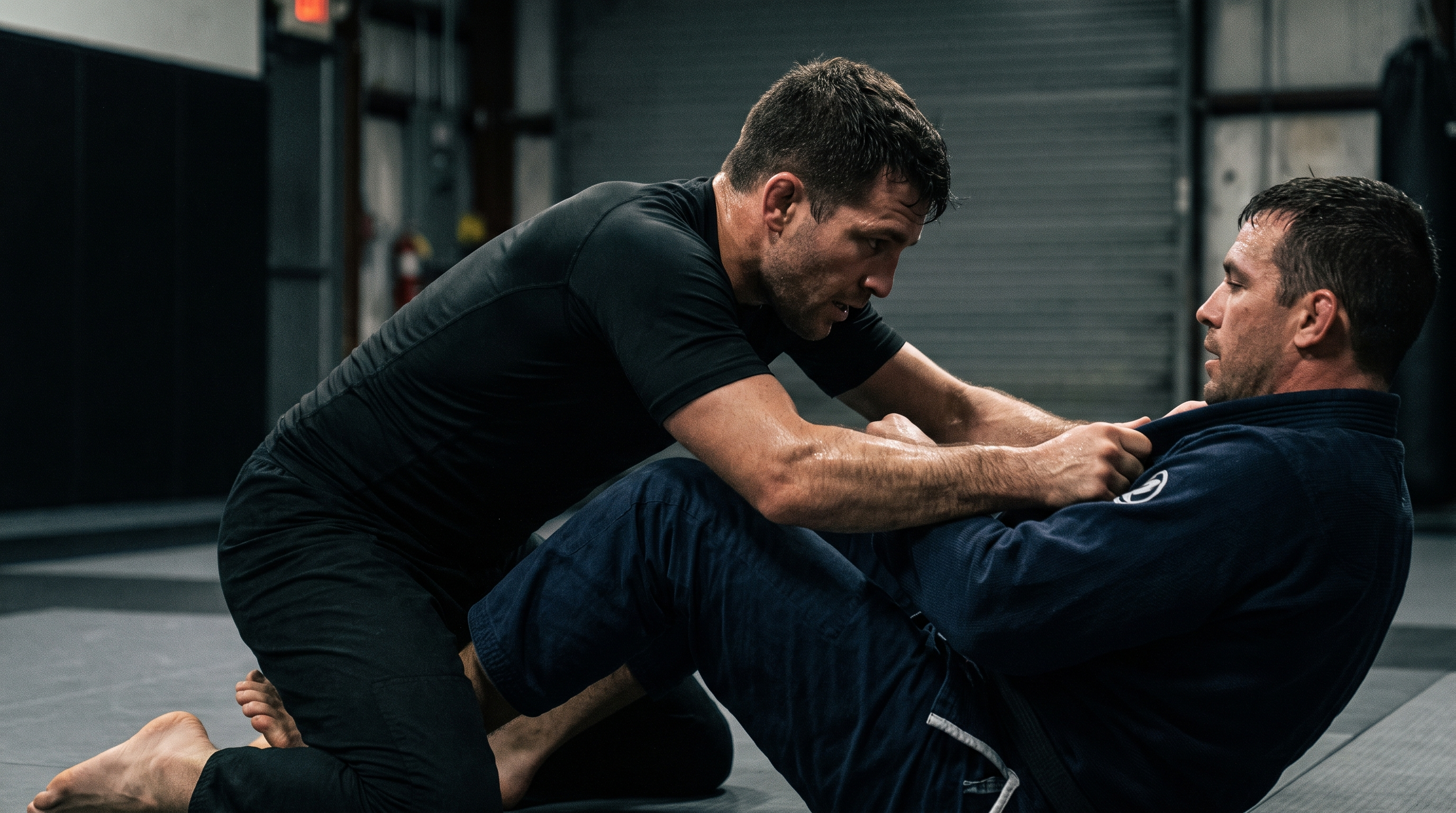
Wrestling Up from Guard: A Modern Sweep System for Hobbyist Grapplers
TL;DR. Wrestling up from guard is a modern sweep pattern where you use frames and hip elevation to expose your opponent's leg, connect to it, and stand up into a single or high crotch instead of chasing traditional sweeps. It works from butterfly, half guard, seated guard, and single-leg X, so a single movement covers most bottom positions. This guide breaks the system into five steps, walks through the mistakes that kill it, and shows how to turn it into a reliable go-to.
Key takeaways
- Wrestling up converts bottom guard into a standing scramble in your favor without needing to be strong or explosive.
- The core pattern — post, elevate, expose, connect, stand — works from butterfly, half guard, seated guard, and single-leg X.
- Most failed reps come from staying low, dropping the head, or hesitating at the moment of standing.
- The move pairs naturally with front headlocks and re-guard, so a stalled attempt rarely gives up position.
- Grip fighting the near sleeve or collar decides whether you get out clean or get flattened.
- Because the pattern repeats across positions, it is one of the highest-ROI moves a hobbyist can drill.
- Filming your attempts and reviewing them between sessions is the fastest way to lock the details in.
Modern jiu-jitsu has quietly shifted. High-level competitors — from Craig Jones and Lachlan Giles to the current ADCC crop — rarely play the flat-on-your-back closed-guard game hobbyists were originally taught. They sit up, frame, and wrestle up into leg entries or top position. For a hobbyist who trains a couple of times a week, this is great news: instead of memorizing dozens of sweeps for dozens of positions, you can learn one hip-forward, standing-based pattern that solves most bottom scenarios. This article breaks the wrestle-up into a repeatable system, the same way you would break down any technique you were trying to actually keep.
Why this happens (and why the old game stops working)
If you started BJJ any time in the last few decades, your first guard was probably closed guard. It's a fine position to learn control from, but two things push hobbyists off it fast:
- Modern passers stand up. Most opponents above white belt will pop the closed guard open and pass standing, which pulls you into a stalled, defensive half guard.
- Points and pressure favor being on top. Every second spent on your back invites a smash pass, a knee slide, or a leg-drag.
The old fix was to learn more sweeps: scissor, hip bump, flower, pendulum, and so on. That works, but it multiplies decisions. The wrestle-up flips the problem: instead of trying to knock a heavy opponent sideways from underneath, you use their posture against them and simply stand up into a leg attack. It's the same shot a wrestler takes from neutral — just started from the ground.
Remember. You are not "sweeping" in the classical sense. You are standing up and taking a leg. Frame that in your head and the details start to click.
A simple system: five steps to wrestle up cleanly
Learn the sequence below from butterfly or seated guard first — the mechanics translate everywhere else.
- Sit up and frame. From your back or from a flat butterfly, sit up onto one hip. Post your inside hand on the mat behind you, and place your outside hand as a frame on their biceps, shoulder, or collar. If they haven't engaged yet, sit up first and force the meeting on your terms.
- Kill the near grip. Their same-side arm is the one that will flatten you. Strip the sleeve grip, two-on-one the wrist, or use a collar tie to keep their posture bent. No grip fight, no wrestle-up.
- Elevate and expose the leg. Load your near hook (butterfly), knee shield (half guard), or shin (seated) under their thigh and lift. You are not trying to sweep them here — you are just floating their weight enough to expose their lead leg so you can connect to it.
- Connect to the leg. As they post to base, shoot your outside hand around the back of their near knee. Bring your head to the inside of their hip. You now have a single-leg from the bottom, with your ear glued to their hip and your hands locked behind their knee.
- Stand and finish. Drive your outside knee to the mat, then post your inside foot up. Pull the trapped leg into your chest, walk your head up their body, and stand. From here you finish the standard single-leg finishes: run the pipe, drive through, or switch to a high crotch.
Optional step 6: failure branch. If they sprawl heavy on your head, you're in a front headlock — a legitimate top position. Do not fight to stand from bad posture. Frame their hip, spin behind, or attack a guillotine and re-guard.
The wrestle-up across common guards
| Starting position | Elevation tool | What you connect to | Finish |
|---|---|---|---|
| Butterfly guard | Inside hook lift | Near-leg single | Run the pipe / high crotch |
| Half guard | Knee shield + underhook | Trapped-side single | Come up on the trapped leg |
| Seated guard | Shin across thigh | Near ankle / knee | Stand into a single |
| Single-leg X | X-frame lift | Already on the leg | Come up + finish |
| Closed guard (open first) | Hip bump + post | Near leg | Bump → catch the leg |
Notice the pattern: the same five steps, just a different tool for the "elevate" step. That's why wrestling up scales so well for hobbyists — one system, many entrances.
Remember. If you can do it from butterfly, you can do it from anywhere. Drill butterfly wrestle-ups until they are boring, then port them to the other positions.
Common mistakes that kill the wrestle-up
Almost every failed rep comes down to one of these:
- Staying too low. If you never actually stand, they will re-pressure and flatten you. The whole point is to get up. Commit.
- Head down. As soon as your head drops below their hip, they get a front headlock or a cross-face. Keep your ear on their hip and your eyes up.
- No grip fight. If their near arm is free, they will post on your face, cross-face you, or underhook first. Fight for the near sleeve or collar tie before you elevate.
- Chasing the sweep, not the leg. You are not looking for a knockdown. You are looking to expose the leg and connect. Trying to "throw" them sideways gives up the shot.
- Hesitating at the stand. The moment your hand is behind their knee, stand. Waiting invites a whizzer or a sprawl.
- Ignoring the failure branch. Wrestle-ups fail often, and that's fine — as long as you know the front-headlock and re-guard exits, a failed rep costs you nothing.
A useful drill: from butterfly, do a set of reps where you only get to step 3 (elevate + expose), then reset. Then a set to step 4 (connect). Then a set to a full stand. Breaking the chain into stages fixes the "I know the move but it doesn't work live" problem far faster than repping the whole sequence every time.
Remember. Failure is a branch, not a loss. Know your front-headlock and re-guard exits before you start hunting the wrestle-up in live rolls.
Where BJJ Memo fits in
The reason most hobbyists never lock in the wrestle-up isn't a bad first exposure — it's that the details fade before the next session. You watch a Craig Jones or Lachlan Giles breakdown on Sunday, drill a version in class Tuesday, and by Thursday the grip sequence and the head position are gone. BJJ Memo is built for that gap: paste the YouTube instructional you were watching, and the app turns it into a structured technique card — steps, key details, and tappable timestamps of the moments that actually matter — filed into your personal library. A short revision the night before training brings the details back. If you want to see more on the retention side, our BJJ Memo blog has related guides. It doesn't replace your coach, and it doesn't replace mat time — it just makes what you already study stick.
Frequently asked questions
Do I need to be athletic to wrestle up from guard?
No. The move is angle- and grip-based, not explosive. You are using their forward posture against them, not muscling them off you. Older grapplers and smaller hobbyists routinely make it their A-game.
Is wrestling up legal in gi and no-gi?
Yes, in both, at all standard rulesets (IBJJF, ADCC, submission-only). Sweep points are awarded once you come up on top with control. The grip-fighting details change — collar and sleeve in gi, wrist and collar tie in no-gi — but the mechanics are identical.
What if my opponent just sits down or pulls guard when I stand?
That's a win. You are now on top in their guard, having reversed the position. From there you can pass, disengage, or start your own leg-entry game.
How is a wrestle-up different from a hip bump sweep?
A hip bump ends with them on their back and you in mount. A wrestle-up ends with you standing with a leg. The wrestle-up is usually higher-percentage against opponents who base out, because you are following their reaction instead of fighting it.
How long does it take to make it reliable in rolls?
For a hobbyist training two or three times a week, expect several weeks of ugly reps before it starts landing live. Isolated positional sparring from butterfly — where the only options are stand up or get passed — is the fastest way to speed that up.
Which instructionals are worth studying for this?
Lachlan Giles' guard-retention and wrestle-up material and Craig Jones' butterfly and half-guard breakdowns are two widely referenced sources. Whatever you pick, save the key moments as a technique card so you don't lose them by next class.
Take the next step
Wrestling up is one of those rare moves that pays back every hour you spend on it. Drill the five-step chain from butterfly, learn the failure branch, and start using it in positional rounds this week. Then, next time you watch a wrestle-up breakdown on YouTube, save it as a technique card in BJJ Memo so it's still fresh when you step on the mat.
For real feedback and safety, train the technique at a legit academy with a qualified coach — BJJ Memo helps you remember and revise, it doesn't replace mat time.
Last updated 2026-09-10.