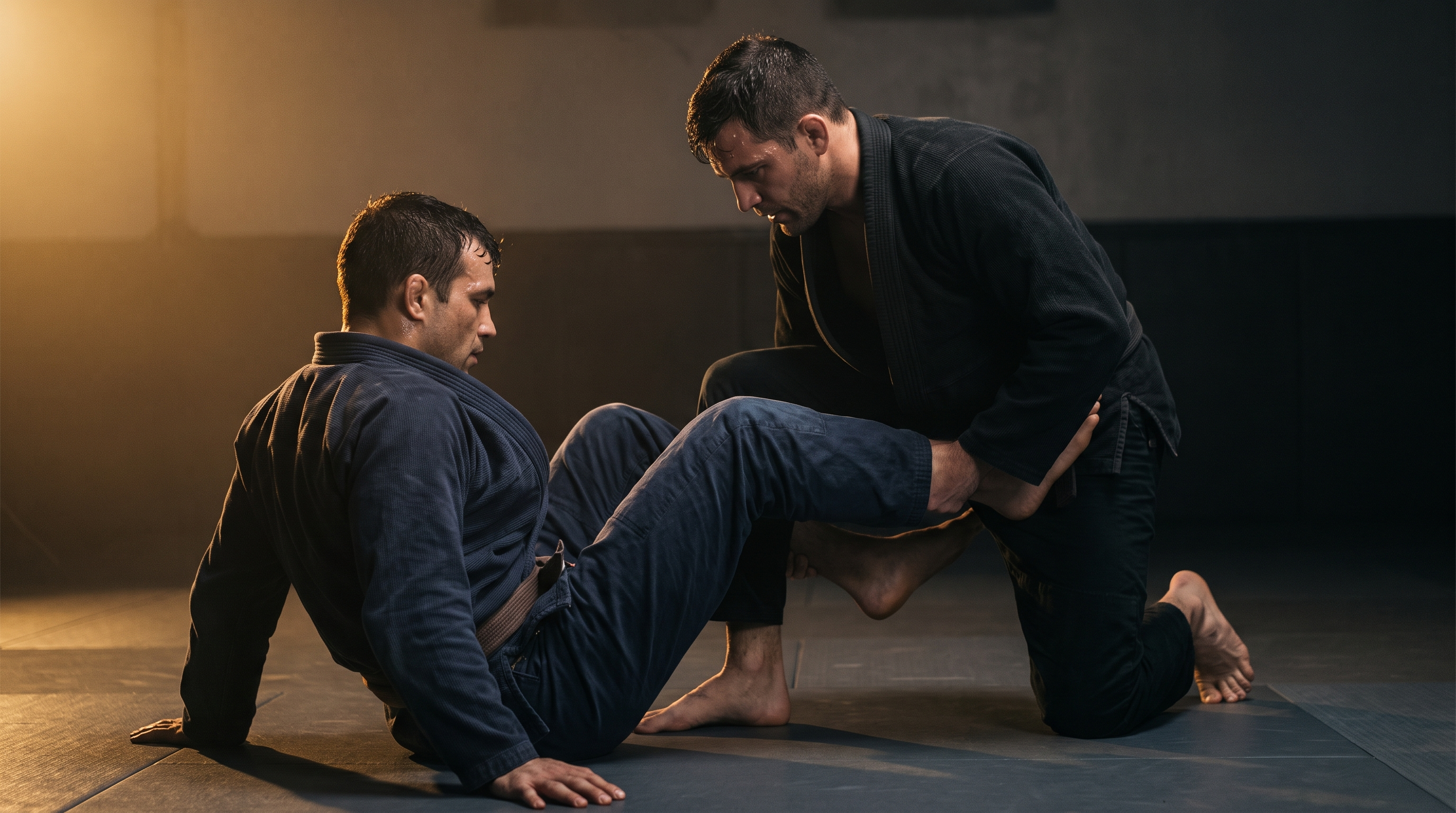
X-Guard for Beginners: How to Enter, Stabilize, and Sweep Without Getting Passed
TL;DR. X-guard is an open-guard position where you sit under your standing partner and control one of their legs with a shape like an X made by your shins. For beginners, the whole game is three things: get there from a position you already play (usually butterfly or single-leg X), lock the frame so their base is broken, then sweep to the side their weight is already going. Most white belts fail at step two — they enter, freeze, and get their guard passed. Learn the frame first, add one entry, add one sweep, and drill that mini-system until it works before adding anything else.
X-guard looks intimidating on YouTube. You watch Marcelo Garcia glide under someone's leg, dump them on their back, and pop up in a single-leg. Then you try it in class, get flattened, and quietly file it under "advanced stuff for later." It does not have to go that way. X-guard is actually a very friendly beginner position once you understand what job each limb is doing. The framework is small: one clean entry, three points of contact that break your partner's base, and one sweep that uses their weight against them. Everything else — the transitions, the leg drags, the back takes — is built on top of that foundation. This guide gives you the minimum viable X-guard game so you can start playing it in live rounds, not just drilling it in isolation.
Why beginners get passed the moment they sit under
The problem is almost never the sweep. It is the ten seconds between entering the position and starting the sweep. When a white belt sits under their partner's leg, three things usually go wrong at once:
- The top shin drifts down to the calf or ankle, so there is nothing pinning the knee.
- The bottom foot slides off the hip, which lets the partner square up and post their weight down.
- The grip is on the wrong side — usually a same-side sleeve grip that does nothing to control posture.
With all three leaks open, your partner just sits down on your head, frees the trapped leg, and passes to side control. The fix is not more athleticism. The fix is understanding that X-guard is a frame, not a hold. You are wedging under your partner's structure and using their own weight to keep you connected. If the frame is right, you barely have to grip hard. If the frame is wrong, no grip will save you.
Remember. X-guard is a wedge, not a wrestle. If you are muscling to stay there, the position is already broken — reset the frame or bail to a safer guard.
The three connections that make X-guard work
| Connection | Where it goes | What it does |
|---|---|---|
| Top shin | Behind partner's knee, blade of the shin up | Bends their knee, kills their ability to post the leg down |
| Bottom foot | On partner's hip (near-side) or under their thigh | Controls distance, prevents them from squaring up |
| Hand grip | Same-side sleeve or pants, at the ankle | Steers their weight, prevents them from stepping out |
When all three are live, your partner is essentially standing on one leg with a broken knee angle and a controlled foot. That is why the sweep works — they are already almost falling.
A simple X-guard system: five steps from entry to finish
Here is a stripped-down system that gives you a working X-guard game. Do not add options until each step is reliable in live rolling.
1. Start from butterfly guard, not from scratch
Do not try to pull directly into X-guard. Play butterfly first. Butterfly is a position most white belts already understand: seated, hooks in, head up, hands fighting for grips. From here you have leverage and options, and the transition to X is short.
2. Elevate the far leg and shrimp under
When your partner posts up to pass — one knee up, one knee down, or fully standing — hook their far leg with your same-side butterfly hook and elevate it slightly. As you elevate, shrimp your hips out so your head slides under their hip on the far side. This is the moment of entry. You are not sweeping yet; you are just getting your body underneath them.
3. Thread the top shin behind their knee
As your hips clear, bring your top shin (the one closer to their standing leg) up and slide it behind the knee of their posted leg. The blade of your shin should press into the back of their knee, forcing a slight bend. This is the single most important detail in the entire position. If the shin is on the calf, you have nothing. If it is behind the knee, they cannot straighten the leg to post their weight down.
4. Plant the bottom foot on the hip and grip the ankle
Your bottom foot goes on the near-side hip (the hip of the leg you are attacking) with the toes pointing outward. Your same-side hand grips the sleeve of the pants at the ankle of the trapped leg. Now all three connections are live. You should feel your partner's weight leaning forward over you — that is good. That means their base is broken forward.
Remember. If your partner's weight is settling down onto you, the frame is inverted and you are about to get passed. Their weight should be tipping forward, over your top shoulder.
5. The technical stand-up sweep
This is the highest-percentage beginner finish. With the frame locked:
- Extend your top leg (the shin behind the knee) to push their trapped leg away from you.
- Simultaneously pull the ankle grip toward your chest.
- As they tip forward, release the bottom hip foot and post your free hand on the mat behind you.
- Come up onto your bottom knee, then your bottom foot — the same motion as a technical stand-up.
- You should end up standing, holding their leg in a single-leg position, with them on their back or seated in front of you.
That is a full sweep, worth two points in IBJJF rules, and it lands you in a dominant standing position rather than in someone's guard.
6. If it stalls, bail — do not stay stuck
If you enter and cannot break their posture within a few seconds, do not sit there and hope. Two safe exits:
- Single-leg X (ashi garami-style, feet outside their hip): slide your bottom foot to the outside of their far hip and use the position to threaten sweeps to the other side. Keep both feet outside the hip line — crossing your feet across their centerline is reaping and is illegal and dangerous.
- Half guard: if they start to pass, drop your top leg down and trap their near leg between your knees. You lose the sweep, but you keep your guard.
7. Drill the mini-system, not a highlight reel
One entry, one frame, one sweep, two bailouts. That is your whole X-guard game for the next three months. Drill it in isolation, then in positional sparring starting from butterfly, then in open rolls. Only after it works in live rounds should you add a second sweep (the back-take is the natural next step).
Common mistakes to fix immediately
These are the errors that show up in almost every beginner's X-guard, in rough order of how badly they cost you.
- Shin too low. The single most common mistake. Your top shin has to be behind the knee, not on the calf. If you cannot get it there, your entry angle was wrong — reset from butterfly.
- Head on the wrong side. Your head should be under your partner's near hip, not stuck out to the side. If your head is exposed, they will crossface you and pass.
- Same-side sleeve grip only. A far-side collar or a same-side pants grip at the ankle is far more useful than a lazy sleeve grip. Grip where you can steer their weight.
- Trying to sweep with strength. If you are pulling and pushing hard, the frame is wrong. Reset it. The sweep should feel like tipping a chair, not deadlifting a person.
- Staying too long. X-guard is a transitional position for beginners. If nothing is happening in a few seconds, bail. Sitting under someone with a broken frame is how you get passed.
- Crossing the feet across their centerline. This is reaping and it can dangerously torque the knee. Keep your bottom foot on the hip or outside the hip line, never crossed to the far side of their standing leg.
- Ignoring their grips. If they get a strong cross-collar or a belt grip and start driving forward, your frame will collapse. Fight their grips before you commit to the entry.
Where BJJ Memo fits into learning X-guard
X-guard is a position with a lot of moving parts, and you will learn it mostly from a mix of class, drilling, and video — probably from instructors like Marcelo Garcia, Lachlan Giles, or your own coach. The problem is not finding the content; the problem is remembering the details a week later, when you are actually in the position live.
BJJ Memo is built for exactly that gap. When you watch a good X-guard instructional on YouTube, you paste the link into the app and it turns the video into a structured technique card — steps, key details, tappable timestamps of the important moments. The card lives in your personal library, filed under "X-guard" or "open guard," and the review flow surfaces it before your next session so the details are fresh on the mat. It does not replace drilling or coaching. It just makes sure the frame details you learned on Sunday are still in your head by Tuesday's rolling. If you want a system for that, the app is on iOS and Android.
Frequently asked questions
Is X-guard legal at white belt?
Yes. X-guard itself is legal at every belt level under IBJJF and most major rule sets. What is not legal at white or blue belt in IBJJF is heel hooks and knee reaping. As long as you keep your feet outside your partner's hip line and do not attack the heel, you are fine. Check your local ruleset before competing.
Do I need to be flexible to play X-guard?
No. X-guard is a shape more than a stretch. If you can sit cross-legged on the floor and get your shin behind someone's knee, you are flexible enough. The position rewards frame and timing far more than mobility.
What is the difference between X-guard and single-leg X?
X-guard is when your shins form an X under your partner's leg, with your top shin behind their knee and your bottom foot on their hip. Single-leg X (sometimes called ashi garami in gi contexts) is a lower, tighter position where you control one leg with both of yours from the outside. Single-leg X is often used as a bailout from X-guard or as a setup for sweeps to the other side.
How long does it take to make X-guard work in rolling?
Realistically, several months of consistent drilling before it starts working against resisting training partners. That is normal for any open-guard position. The technical stand-up sweep is the fastest to get live because it is a natural human motion — you are just standing up while holding a leg.
Can I play X-guard in no-gi?
Yes. X-guard works well in no-gi, and it is a common entry to leg-lock systems at higher belts. For beginners in no-gi, focus on the same frame — shin behind the knee, foot on the hip, grip on the ankle — and use the technical stand-up sweep. Skip the leg-entangled finishes until you have training partners who can tap safely and a coach who teaches them.
Should I learn X-guard or closed guard first?
Closed guard first. Closed guard teaches you posture control, grip fighting, and hip movement — all of which you need for X-guard. Once your closed guard feels solid and you have a working butterfly, X-guard is the natural next step. If you want a starting point, read our guides on the basics of closed guard and how to build a beginner guard game.
Wrap up: small game, sharp game
X-guard is not a party trick. It is a legitimate open-guard position that becomes reliable once the frame details are burned in. Start from butterfly, enter clean, lock the three connections, tip them with a technical stand-up. If it stalls, bail. Do not add options until the basics work in live rounds.
And next time you watch an X-guard instructional, save it as a technique card in BJJ Memo so the details are in front of you before your next roll. Build a small library of the positions you actually play, and revise them the day before training — that is how techniques stop leaking out of your head.
Teacher disclaimer. This article is a written summary to help you remember and revise. For real feedback, timing, and safety — especially anything involving leg entanglements — train the position at a legit academy with a qualified coach. BJJ Memo helps you retain what you learn; it does not replace mat time.
Last updated 2026-09-29.